Intuition
An initial value problem fixes the first two coefficients: the value at the starting point is the constant term and the slope is the coefficient of the first power. Every other coefficient then follows from the recurrence, so the solution is determined term by term. When the starting point is not zero, the series is written in powers of the distance from it, and the same steps apply after a change of variable.
Dead reckoning at sea: from a known position and heading, each short leg follows from the one before, and the course unfolds from the start. The further from the start, the more legs are needed to stay on course.
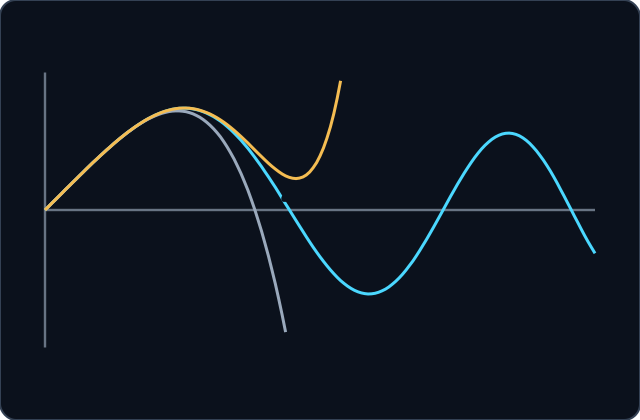
with , : . Near the start two terms are already close; further out each partial sum breaks away, and more terms are needed to follow the solution.
The start fixes two coefficients
For with and given, write . Then and , and the recurrence gives every later coefficient. To use the method of the last lessons unchanged, substitute : the equation in is expanded about , with and rewritten in .
Working from the start
- , , : , , and the recurrence gives .
The equation gives the third coefficient directly
The coefficient of the square is half the second derivative at the starting point. The equation, evaluated there, gives that second derivative from the value and the slope. Those are the first two coefficients, so the third follows from them without writing any series at all.
Proof steps
The coefficients are derivatives divided by factorials.
Evaluate the equation at the starting point.
Replace the value and the slope by the first two coefficients.
Applications
Practice
The Start Fixes Two
The value at the starting point is the constant term, and the slope is the coefficient of the first power.
Try it
and . Which series solution begins correctly?
Try it
, , . What is ?
Try it
For initial values given at , the series is written in powers of .
Try it
, , . How does the solution begin?
Try it
Using , estimate . Give three decimal places.
Try it
A partial sum of a series solution is equally accurate at every point where the series converges.
Try it
To expand about with the method of the last lessons, which substitution is made?
Try it
, , . What is the coefficient of in the series?
Final checkpoint
Try it
What does a series solution of a second-order initial value problem leave free?
Try it
For , the coefficient can be found from the equation at , without writing any series.
Try it
with , . What is ? Give three decimal places.
Completion
Lesson complete
Great work! You now know how to:
- fix the first coefficients from initial values
- expand about a starting point other than zero
- derive the third coefficient straight from the equation
- judge how far a partial sum can be trusted