Intuition
Where does the method work, and how far does the series reach? Put the equation in standard form, with the coefficient of the second derivative equal to one. A point where both remaining coefficients are convergent power series is an ordinary point, and there the method always works; a point where one of them blows up is singular. The series about an ordinary point converges at least out to the nearest singular point — even a singular point that is a complex number, off the real line.
A lamp in a dark room lights everything up to the nearest wall. The singular points are the walls, and the series about an ordinary point reaches at least as far as the nearest one, in every direction.
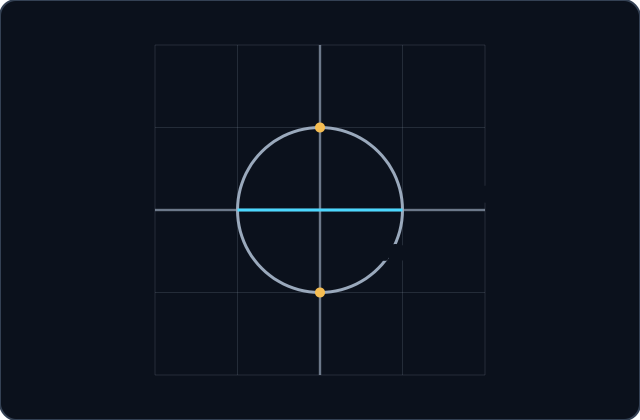
The complex plane of for . Its leading coefficient vanishes at , at distance from , so the series about is guaranteed only inside the dashed circle — on the real line, for — although the equation has no real singular point at all.
Where the method is guaranteed
Write the equation as . The point is ordinary if and are analytic there — equal to convergent power series about — and singular otherwise. For with polynomial coefficients and no common factor, the singular points are the zeros of , complex ones included. About an ordinary point there are two independent series solutions, and they converge at least out to the nearest singular point: Fuchs's theorem, used here without proof. Its algebraic half is the theorem below.
Finding the reach
- has the singular points ; about its series converge for at least.
At an ordinary point the first two coefficients determine the rest
Substitute the series into the equation in standard form. The second derivative, shifted, puts n + 2 times n + 1 times the coefficient of index n + 2 at the power xⁿ. The terms with p and q, products of power series, put there only coefficients of lower index. Setting the total to zero gives each coefficient from the earlier ones, because the factor in front of it is never zero, and only the first two are left free.
Proof steps
The second derivative contributes the coefficient of highest index.
Products of power series put only lower coefficients at the power xⁿ.
Setting the coefficient of xⁿ to zero, and (n + 2)(n + 1) is never zero.
Only the first two coefficients are left free: two independent solutions.
Applications
Practice
Standard Form First
Divide by the coefficient of y″. A point where the remaining coefficients blow up is singular.
Try it
What are the singular points of ?
Try it
. How far from is its series solution about guaranteed to converge?
Try it
has no real singular points, so its series about is guaranteed to converge for every real .
Try it
About which points is a series solution of guaranteed?
Try it
is expanded about . How far from is the series guaranteed to converge?
Try it
is a singular point of Bessel's equation .
Try it
At an ordinary point, why does each coefficient after the second follow from the earlier ones?
Try it
is expanded about . What radius of convergence is guaranteed?
Final checkpoint
Try it
Legendre's equation has the polynomial solution . Where does that series converge?
Try it
To find the singular points of , the equation must first be divided by .
Try it
How many singular points does have?
Completion
Lesson complete
Great work! You now know how to:
- tell ordinary points from singular ones
- find the guaranteed reach of a series, complex singular points included
- prove that the first two coefficients determine the rest
- say why a particular series may reach further than guaranteed