Intuition
Substitute the series into the equation, shift the indices so that every sum is written in the same power of x, and collect: the result is one power series that must be zero, so every one of its coefficients must be zero. Each of those conditions is an equation linking a few coefficients of the solution. Worked through for an equation whose answer is already known, the method finds that answer, which is the best evidence that it works.
Balancing a chemical equation atom by atom. Everything on one side must be matched on the other, element by element; here, power by power.
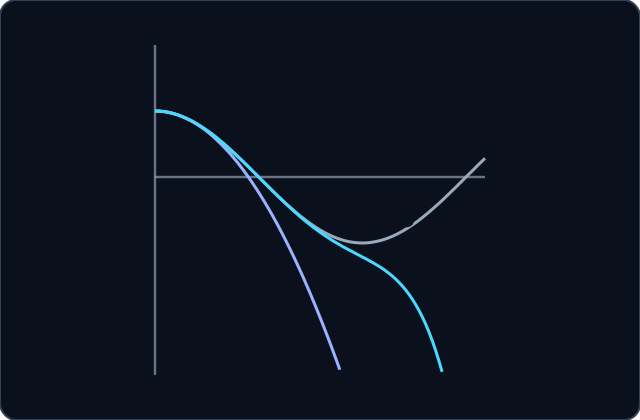
with , . The recurrence gives , and its partial sums of degree and close in on , dashed. All three are even, so the right half says everything: the method finds the answer chapter four gave.
Substitute, shift, match
To solve near with and polynomials: substitute and its term-by-term derivatives; shift the index in each sum so that every sum runs over ; combine them into one series ; and set every to zero. For this gives .
The bookkeeping
- Shifting an index changes nothing but the name: put , then rename as .
- For : , so .
A power series that is zero has zero coefficients
If the series is zero on an interval about zero, so is every derivative of it. By the last lesson each coefficient is a derivative at zero divided by a factorial, so each coefficient is zero. That is why, after substituting, every coefficient of the combined series may be set to zero on its own.
Proof steps
Suppose the series vanishes near zero.
Every derivative of the zero function is zero.
The coefficients are the derivatives at zero divided by factorials.
Applications
Practice
Shift the Index
Rename the index so that every sum runs over the same power of x. Nothing changes but the label.
Try it
Written as a sum over from , what is ?
Try it
For with , the recurrence is . What is ?
Try it
If for every near , then every is .
Try it
Written over , what is ?
Try it
For , and . What is ? Give three decimal places.
Try it
For with and , the series method gives .
Try it
For , what does the constant term, the coefficient of , give?
Try it
For the coefficient of gives . With , what is ?
Final checkpoint
Try it
After substituting and combining, why may each coefficient of the combined series be set to zero separately?
Try it
Before the coefficients are matched, every sum must be rewritten so that it runs over the same power of x.
Try it
For with , matching gives . What is ? Give two decimal places.
Completion
Lesson complete
Great work! You now know how to:
- substitute a series and shift its indices
- prove that a zero series has zero coefficients
- derive a recurrence by matching powers
- recover the cosine and the sine from their equation