Intuition
At a singular point a power series can fail, but at the mildest kind — a regular singular point, such as the origin for Bessel’s equation — a small change rescues the method. Multiply the series by a power of x whose exponent r is to be found: the lowest power in the equation then gives a quadratic for r, the indicial equation, and each root starts a series. The exponent need not be a whole number, so a solution can behave like the square root of x near the singular point, or like a negative power.
A key that almost fits a lock. The power series is the key; a regular singular point is a lock with one extra ward, and the factor x to the r is the notch filed into the key so that it turns.
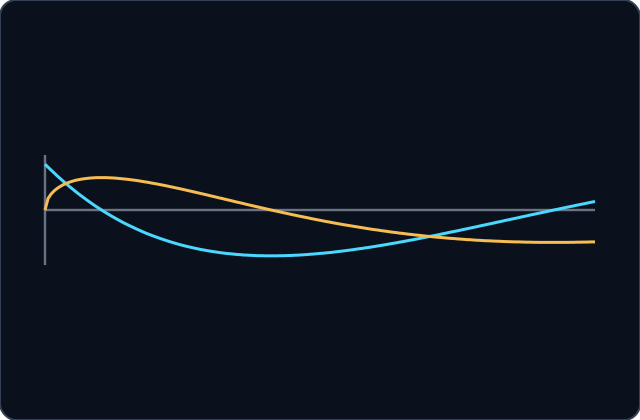
has a regular singular point at and the exponents and . The two Frobenius solutions are and ; the second starts like , with a vertical tangent that no power series could have.
A power times a power series
A singular point is regular if and are analytic there. At a regular singular point , try with . The lowest power gives the indicial equation below, where and are the values at of and . Its larger root always gives a solution; the smaller gives a second when the roots do not differ by a whole number — otherwise the second solution may need a logarithm, which is left to a later course.
Exponents at a singular point
- : and , so , , and gives and .
The indicial equation
Multiply the equation by x squared, so that its coefficients become x p and x squared q, both power series at a regular singular point. Substituting the trial solution, each term starts at the power x to the r: the second derivative with r times r minus 1, the first derivative with p0 times r, and y itself with q0. The coefficient of that lowest power must vanish, and since a0 is not zero, r must solve the indicial equation.
Proof steps
Multiply the standard form by x squared.
The lowest power in each term is x to the r.
Near zero, x p starts with p0 and x squared q with q0.
The coefficient of the lowest power must vanish.
Applications
Practice
Regular Singular Points
A singular point is regular when x times p and x squared times q are still power series there. Then a power times a power series works.
Try it
Which equation has a regular singular point at ?
Try it
The indicial equation of is . What is its larger root?
Try it
A Frobenius solution can behave like the square root of x near the singular point.
Try it
What are the exponents of ?
Try it
For , what is , the value at of ?
Try it
is a regular singular point of .
Try it
What are the exponents at of Bessel's equation ?
Try it
For with , the recurrence is . With , what is ? Give three decimal places.
Final checkpoint
Try it
Why does the Frobenius method multiply the power series by x to the r?
Try it
At a regular singular point, the larger root of the indicial equation always gives a Frobenius solution.
Try it
has solutions . What is the positive exponent ?
Completion
Lesson complete
Great work! You now know how to:
- recognise a regular singular point
- derive and solve the indicial equation
- find a Frobenius series from its recurrence
- say why a power of x in front rescues the method