Intuition
The methods so far need constant coefficients, or a lucky substitution. Many equations of physics have variable coefficients — Airy’s equation for light near a rainbow’s edge, Legendre’s and Bessel’s equations for spheres and drums — and their solutions are not built from exponentials, sines or polynomials. They can still be found as power series: guess that the solution is an infinite polynomial, and let the equation decide its coefficients one by one.
Building a curve from its Taylor polynomials, one term at a time. Each new term makes the approximation better near the starting point, and the equation itself says what every term must be.
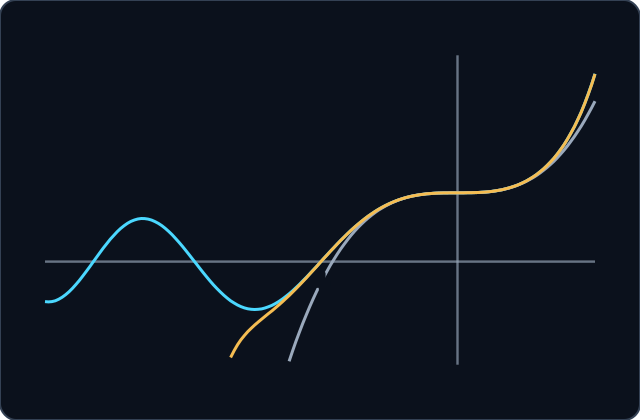
Airy's equation with , . Its solution, , is no combination of familiar functions. Two terms of the series fit it only near ; four fit it much further out; the full series converges for every .
A solution as a power series
A power series converges on an interval about , and inside that interval it may be differentiated term by term — both are proved in the analysis course and used here. The method of this chapter assumes a solution of that form, substitutes it into the equation and reads off equations for the coefficients. It is needed when the coefficients vary: for with or not constant there is no characteristic equation.
What a series solution is
- and : the first two coefficients are the initial value and the initial slope.
The coefficients are derivatives at the centre
Differentiate the series k times, term by term, which the analysis course allows inside the interval of convergence. At zero every power of x vanishes except the constant term, which is k factorial times the k-th coefficient. So each coefficient is fixed by a derivative of the function at zero, and two series for the same function have the same coefficients.
Proof steps
Differentiate k times, term by term.
At zero every term but the first vanishes.
So the coefficients are fixed by the function: it has at most one power series about a point.
Applications
Practice
When Series Are Needed
Constant coefficients have a characteristic equation. Variable coefficients usually do not, and a power series takes its place.
Try it
Which equation needs a series solution rather than a characteristic equation?
Try it
A series solution has and . What is ?
Try it
Two different power series about 0 can converge to the same function on an interval.
Try it
If , what is ?
Try it
has . What is the coefficient of in its series?
Try it
Substituting into with gives .
Try it
What can be said of the solutions of Airy's equation ?
Try it
The solution of with , begins . Using these three terms, what is ? Give two decimal places.
Final checkpoint
Try it
In a series solution of a second-order equation, which coefficients are left free, to be fixed by the initial conditions?
Try it
Inside its interval of convergence, a power series may be differentiated term by term.
Try it
How many coefficients of a series solution of a third-order linear equation does the equation leave free?
Completion
Lesson complete
Great work! You now know how to:
- say when a series solution is needed
- read the initial value and slope off a series
- prove that the coefficients are derivatives at the centre
- estimate a solution from the first terms of its series