Intuition
A population cannot grow in proportion to itself for ever, because the habitat runs out. The cheapest honest repair is to multiply the growth rate by a factor that falls to zero as the population reaches what the habitat carries. The result is the most-studied equation in this chapter, and everything about it can be read from its phase line before a single integral is attempted.
A room filling with people. While it is nearly empty each new arrival brings friends and the crowd grows in proportion to itself; as the room fills, arrivals slow, and at capacity nobody else comes in. The growth rate is the exponential rate scaled by the fraction of the room still free.
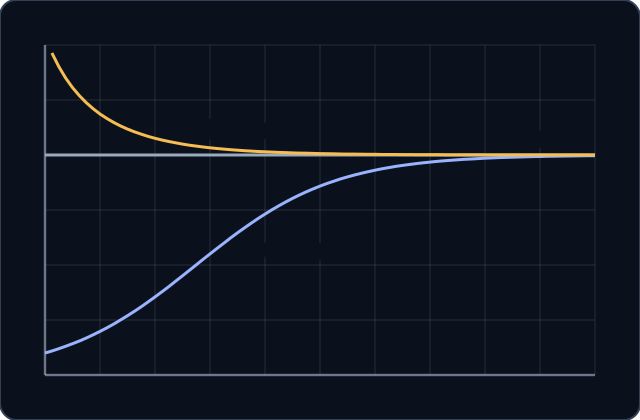
Solutions of . From below the curve is S-shaped, fastest at half the capacity; from above it falls. Both approach the capacity and neither reaches it.
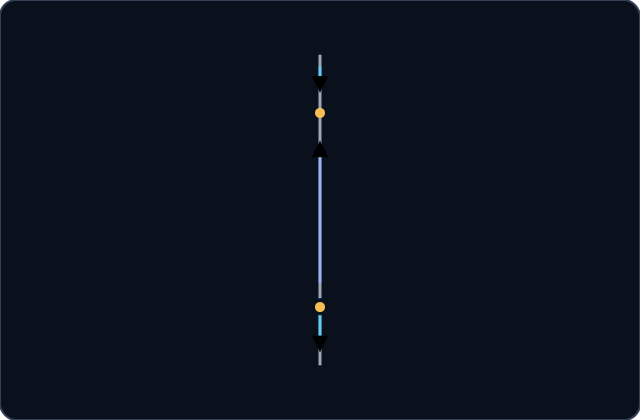
The same equation as a phase line: zero repels, the capacity attracts, and every positive start ends at the capacity. Everything the curves show is already here.
The equation, its equilibria and its curve
The logistic equation is , with the intrinsic growth rate and the carrying capacity. It has equilibria at , unstable, and at , stable. Separation and partial fractions give the solution in closed form, but the phase line already says that every positive start ends at .
What the model says
- For small the bracket is near one and the equation is nearly : the model begins as exponential growth.
- For near the bracket is near zero and growth stops. The capacity is where the habitat is full.
Applications
Practice
Two Equilibria, and Which Is Which
The logistic right-hand side vanishes at zero and at the capacity. The derivative test settles both.
Try it
For , which equilibrium is stable?
Try it
For , at what population is growth fastest?
Try it
While the population is far below the capacity, the logistic model behaves much like exponential growth.
Try it
A population starts above its carrying capacity. What does the logistic model predict?
Partial Fractions Make the Integral Possible
Separating gives an integral of one over a quadratic in the unknown. Splitting it into two simple fractions is what makes it doable.
Try it
What shape does the closed-form solution of the logistic equation have?
Try it
The long-run behaviour of the logistic model can be found without solving the equation.
Try it
What is the carrying capacity in ?
Try it
In a town of people, a rumour spreads at a rate proportional to the product of those who know it and those who do not. Which equation is that?
Final checkpoint
Try it
For , what is the growth rate when ?
Try it
Doubling in the logistic equation changes what?
Try it
The logistic curve rising from a small start has an inflection at half the carrying capacity.
Completion
Lesson complete
Great work! You now know how to:
- write the logistic equation and name its two constants
- find its equilibria and classify them
- read the whole of its long-run behaviour off the phase line
- say where the curve is steepest, and why the model begins as exponential growth