Intuition
The direction field of an autonomous equation repeats sideways, so all the information in it lives on a single vertical line. Mark the equilibria on that line and put an arrow on each interval between them, pointing up where the rate is positive and down where it is negative. That one picture predicts the fate of every solution of the equation, and drawing it takes no integration at all.
A map of a river reduced to a single strip: where the current runs upstream, where it runs downstream, and where it is still. You do not need the whole map to know where a leaf dropped in will end up.
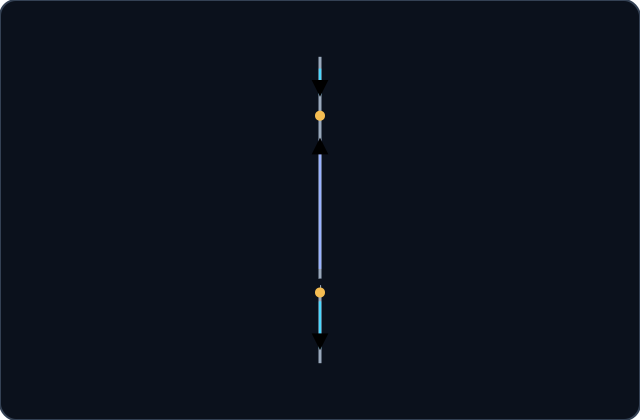
The phase line of . Below zero the rate is negative and the arrow points down; between the equilibria it is positive; above three it is negative again. Every solution follows its arrow.
Drawing one, and what it tells you
The phase line of is the line of values of the unknown, with the equilibria marked and each interval between them carrying an arrow: upward where there, downward where . Since is continuous and does not vanish inside such an interval, the sign is the same throughout it, so one arrow describes the whole interval.
Reading it
- The arrows are found by testing one convenient value in each interval, because the sign cannot change without a root.
- A solution starting in an interval moves the way the arrow points, monotonically, and approaches the equilibrium the arrow points at.
- If the arrow points away from every neighbouring equilibrium the solution leaves the region — possibly to infinity, and possibly in finite input.
- The phase line is a picture of the equation, not of a solution: it holds every solution at once, with the starting height left free.
- Only an autonomous equation has one. For the arrow at a height would depend on where along the input it is drawn.
Applications
Practice
Test One Value in Each Interval
Between two neighbouring equilibria the sign of f cannot change, so one test value settles the arrow for the whole interval.
Try it
For , which way does the arrow point on the interval above ?
Try it
A phase line has equilibria at and , with the arrow up below , down between and , and up above . Where does a solution starting at go?
Try it
Every first-order equation has a phase line.
Try it
How many intervals does the phase line of have?
One Sign to an Interval
Between neighbouring equilibria the right-hand side is continuous and never zero, so by the intermediate value theorem of the analysis course it cannot change sign.
Try it
Between two neighbouring equilibria the right-hand side keeps one sign.
Try it
For , what does the phase line look like?
Try it
For , where does a solution starting at go?
Try it
A phase line describes one solution of an equation.
Final checkpoint
Try it
For , how many equilibria are there?
Try it
On a phase line, what happens to a solution whose interval has an arrow pointing away from both neighbouring equilibria?
Try it
A solution moving towards an equilibrium reaches it in finite input.
Completion
Lesson complete
Great work! You now know how to:
- draw the phase line of an autonomous equation from the sign of its right-hand side
- read the fate of any solution off it without integrating
- say why one test value settles the arrow for a whole interval
- explain why a solution approaches an equilibrium without reaching it