Intuition
The simplest interesting autonomous equation says the rate is proportional to the amount. Separating it takes two lines and gives the exponential, and the sign of the constant decides everything: growth without bound one way, decay to nothing the other. The model is exact for radioactivity, good for money, and wrong for populations over any long stretch — which is what the next lesson repairs.
Interest paid on interest. Each unit of the balance earns at the same rate, so the balance earns in proportion to itself, and the total accelerates without anything about the rate ever changing.
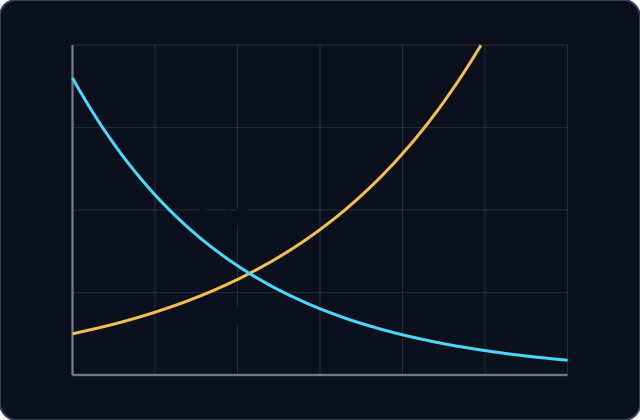
Both curves solve . A positive constant gives growth that steepens for ever; a negative one gives decay that flattens towards zero and never arrives.
The equation and its solution
The equation with has the single solution . It has one equilibrium, , unstable when and stable when . The constant is a rate per unit of the input, and it is fixed by one measurement beyond the starting value.
The numbers people actually ask for
- Half-life. Decay halves in a fixed time whatever the starting amount: gives .
Applications
Practice
Proportional Rate, Exponential Answer
Separating the proportional-rate equation gives the exponential, and the starting value is the factor in front.
Try it
What solves with ?
Try it
A colony obeys with the input in hours. To the nearest tenth of an hour, how long does it take to double?
Try it
The half-life of a decaying quantity does not depend on how much there is to begin with.
Try it
What is the stability of the equilibrium for ?
Try it
A sample decays from to in years. What is its half-life, in years?
Try it
Exponential growth is a good model of a population over any length of time.
A Constant Term Is a Shift
The equation with a constant added is the same equation about a different level: shift the unknown by the equilibrium and the constant disappears.
Try it
Which substitution turns into the proportional-rate equation?
Try it
Coffee at degrees cools in a room at . If the difference halves every minutes, what is the temperature after minutes?
Final checkpoint
Try it
A quantity decaying exponentially reaches zero in finite input.
Try it
A quantity obeys . Measurements give and . What is ?
Try it
For with a positive starting value, the sign of decides whether the solution grows or decays.
Completion
Lesson complete
Great work! You now know how to:
- solve the proportional-rate equation and use its solution
- compute a half-life or a doubling time, and say why the starting value drops out
- turn an equation with a constant term into this one by shifting
- say where the exponential model stops being honest