Intuition
The roots of the right-hand side of an autonomous equation are the states in which nothing changes. They are solutions — the simplest ones the equation has — and they are also the scaffolding for everything else, because no other solution can cross them. Finding them is solving one algebraic equation, and once they are found the qualitative picture is nearly complete.
A ball on a hilly landscape is at rest at the bottom of a valley and at the top of a ridge. Both are equilibria; only one of them survives a nudge. The algebra finds both at once and says nothing yet about which is which, and that is the next lesson.
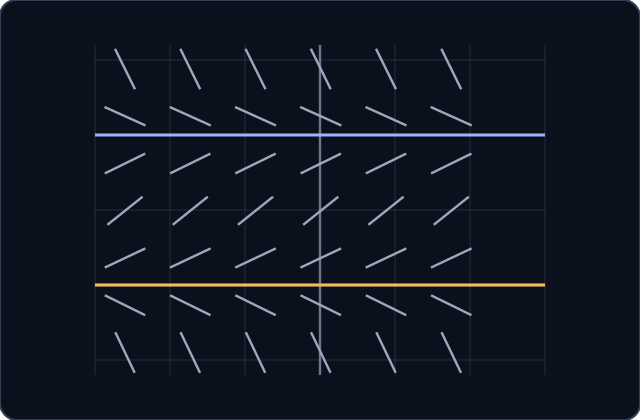
The field of . The marks are flat exactly along the two levels where the right-hand side vanishes, and those two horizontal lines are themselves solutions.
Where the right-hand side vanishes
An equilibrium of is a number with . The constant function is then a solution, called an equilibrium solution; in the plane it is a horizontal line, and where the uniqueness condition holds no other solution meets it. The equilibria are found by solving one algebraic equation and nothing else.
What they are and are not
- An equilibrium is a value of the unknown, not of the input. Asking where a solution is in equilibrium is asking at what height, never at what time.
- has equilibria at and . has none, because the exponential is never zero, and every solution of it is strictly increasing.
Applications
Practice
Set the Right-Hand Side to Zero
An equilibrium is a height at which the rate is zero. Finding them is solving one algebraic equation in the unknown.
Try it
What are the equilibria of ?
Try it
An equilibrium of an autonomous equation is a value of the unknown, not of the input.
Try it
Which equation has no equilibria at all?
Try it
How many equilibria does have in the range ?
Between Two Equilibria the Sign Never Changes
If f had opposite signs at two heights between neighbouring roots, it would vanish between them, and that would be another root. So on each strip the motion is all one way.
Try it
For , what does a solution with do?
Try it
The equation has two equilibria, because the square has two roots.
Try it
For , what is the equilibrium speed?
Try it
An equation that is not autonomous can still have a constant solution.
Final checkpoint
Try it
For , a solution starts at . What value does it approach as the input grows?
Try it
Which equation has the most equilibria?
Try it
A solution of an autonomous equation with a smooth right-hand side can cross an equilibrium level.
Completion
Lesson complete
Great work! You now know how to:
- find every equilibrium by solving one algebraic equation
- say why an equilibrium is a height and never a time
- use the sign of the right-hand side on a strip to say which way solutions move
- explain why an equilibrium level cannot be crossed