Intuition
Once the variables are apart, each side is integrated in its own variable and one constant appears. Two things then need care. Dividing by a factor of the unknown is only legal where that factor is not zero, and wherever it is zero there is usually a constant solution that has just been thrown away. And the result is often an implicit relation, which may be worth leaving alone.
Cancelling a factor in ordinary algebra loses a root: from dividing by gives and quietly discards . Separation does exactly the same thing to a differential equation, and the discarded root is a whole solution.
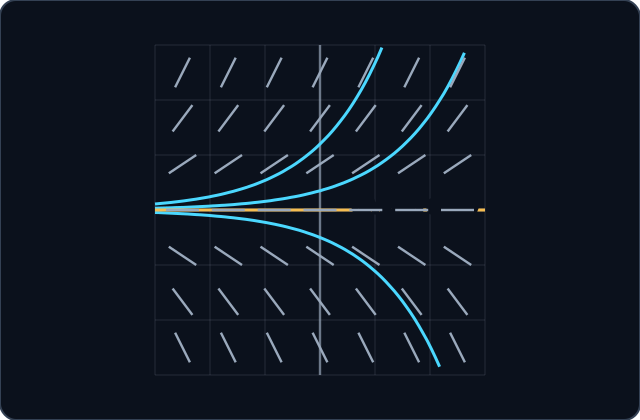
Every curve solves , and so does the flat line along the axis. Dividing by to separate is illegal exactly where that line is, which is why it has to be put back by hand.
The method, and the two cares
Divide by , multiply by , integrate each side in its own variable, and let one constant carry the difference. Then look back at the division: every root of gives a constant solution, and it is a solution of the original equation whether or not the family produces it. Solve for if it is easy and leave the relation implicit if it is not.
Doing it, and checking it
- One constant, not two. on each side would give two, but their difference is a single arbitrary constant, so it is written once on the right.
- Every root of gives the constant solution . Check each against the original equation and add the ones that survive.
- The constant may be renamed as it is carried. becomes and then , where is any non-zero number — and is the solution that was divided away.
Why integrating both sides is legitimate
Separation looks like moving differentials about, which is not by itself an argument. The argument is the chain rule. Let H be an antiderivative of one over h and G one of g. Then the left-hand side of the separated equation is exactly the derivative of H composed with y, by the chain rule. So the equation says two functions of x have the same derivative, and two functions with the same derivative on an interval differ by a constant. That is the whole of it, and it explains why the constant appears once rather than twice.
Proof steps
Start from the separated equation, valid wherever h(y) is not zero.
The chain rule: the left-hand side is the derivative of H along the solution.
So two functions of x have equal derivatives on the interval.
Functions with the same derivative on an interval differ by a constant, which is where the single arbitrary constant comes from.
Applications
Practice
Separate, Integrate, One Constant
Each side is integrated in its own variable, and the two constants are combined into one on the right.
Try it
What is the general solution of ?
Dividing Throws a Solution Away
Separation divides by h(y). Wherever h is zero that step is illegal, and the constant function there is a solution the family will not contain.
Try it
Separating gives the family . Which solution has been lost?
Try it
Integrating both sides of a separated equation produces two arbitrary constants.
Try it
For with , how long does it take for to halve?
Leave It Implicit When Untangling Costs More Than It Buys
Separation often ends in a relation between x and y. Solving for y may need a choice of branch, and the implicit form holds every branch at once.
Try it
Separating and integrating gives which relation?
Try it
An implicit solution can be checked by implicit differentiation.
Try it
Solve with .
Try it
How many constant solutions does have?
Final checkpoint
Try it
A student solves and writes: ", integrate, done." What has gone wrong?
Try it
With a separable equation it is worth applying the initial condition before untangling a messy implicit relation.
Try it
What is the general solution of ?
Completion
Lesson complete
Great work! You now know how to:
- carry out a separation and combine the two constants into one
- find the constant solutions that dividing threw away, and put them back
- decide when to leave an answer implicit
- say why the chain rule is what makes integrating both sides legitimate