Intuition
An equilibrium is stable if a small disturbance dies away and unstable if it grows. The phase line answers the question by inspection: arrows pointing in on both sides mean stable, arrows pointing out mean unstable, and one of each means the equilibrium attracts from one side and repels from the other. There is also a test in one derivative, which is the version that survives into the chapter on systems.
A marble at the bottom of a bowl and a marble balanced on an upturned bowl are both at rest. Nudge each: one returns, the other leaves and does not come back. Nothing about being at rest distinguishes them, and everything about what happens next does.
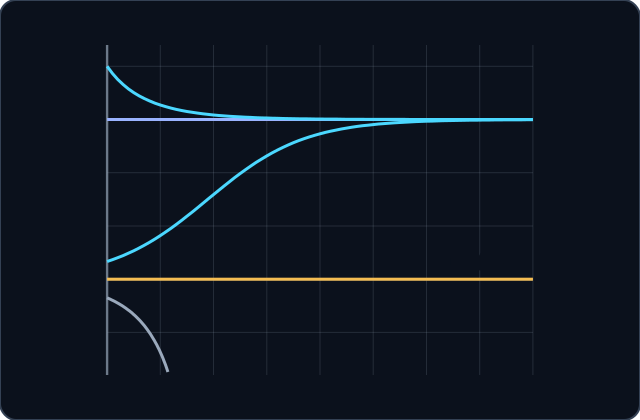
Solutions of . Everything starting above zero is drawn to the upper level; anything starting below zero leaves. The same two equilibria, opposite fates.
Stable, unstable, and the derivative test
An equilibrium of is stable if every solution starting near enough to approaches it, and unstable if solutions starting arbitrarily near it leave a fixed neighbourhood. When the equilibrium is stable and when it is unstable; when the test says nothing and the phase line has to be read directly.
Using it
- means crosses zero from positive to negative there, so the arrow below points up and the one above points down: both point in.
- leaves the case open. has and its single equilibrium attracts from below and repels from above — it is semi-stable.
Why a negative derivative means stable
The derivative being negative at the root says how f behaves just on either side of it. Since the derivative is the limit of the difference quotient and that limit is negative, the quotient is negative for heights close enough to c. Above c the denominator is positive, so f is negative there, and the arrow points down. Below c the denominator is negative, so f is positive, and the arrow points up. Both arrows therefore point at c, and a solution starting near it is monotone and trapped, so it converges to c.
Proof steps
Start at an equilibrium.
A negative derivative makes the difference quotient negative close by.
Above the equilibrium the denominator is positive, so f is negative and the solution falls.
Below it the denominator is negative, so f is positive and the solution rises.
Either way the solution moves towards c, monotonically and without crossing it, so it converges there.
Applications
Practice
Arrows In, or Arrows Out
Read the phase line at the equilibrium. If both neighbouring arrows point at it, it is stable; if both point away, unstable; if one of each, semi-stable.
Try it
For , which equilibrium is stable?
One Derivative Settles It
Differentiate the right-hand side and evaluate at the equilibrium. Negative means stable, positive unstable, zero means the test is silent.
Try it
For , what does the derivative test say about ?
Try it
If at an equilibrium, the equilibrium is stable.
Try it
For , how does the equilibrium at behave?
Try it
For , what is ?
Try it
Stability is a statement about solutions starting near the equilibrium.
Try it
A model has a stable equilibrium at , an unstable one at and another stable one at . A population at is given a boost of . What happens?
Try it
A phase line has an arrow pointing up below an equilibrium and up above it. What is it?
Final checkpoint
Try it
How many stable equilibria does have?
Try it
A real system modelled by an autonomous equation is unlikely to be found sitting at an unstable equilibrium.
Try it
For which equation does the derivative test fail to classify the equilibrium at ?
Completion
Lesson complete
Great work! You now know how to:
- decide stability from the arrows of a phase line
- apply the derivative test and say when it is silent
- recognise a semi-stable equilibrium
- read an unstable equilibrium as a threshold