Intuition
The linearisation decides the local picture whenever it can. If every eigenvalue of the Jacobian has negative real part the equilibrium is asymptotically stable, and if one has positive real part it is unstable, whatever the neglected terms do; saddles stay saddles, nodes stay nodes and spirals stay spirals. The one case it cannot decide is the borderline: purely imaginary eigenvalues, a linear centre, which the smallest nonlinear term can turn into a spiral winding either way.
A barometer forecast. When the pressure is falling fast, the forecast is reliable whatever the details; when it holds exactly on the boundary, the details decide, and the barometer cannot.
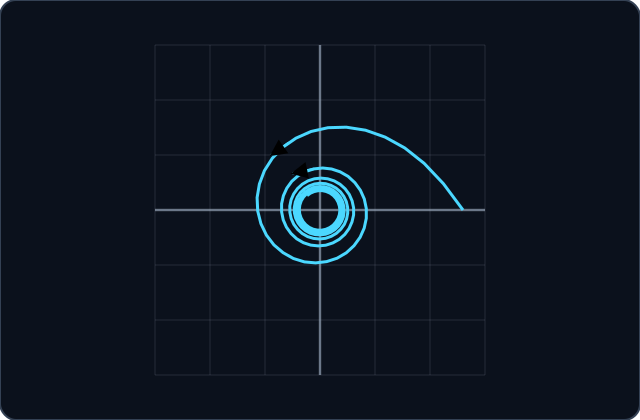
, with . Its Jacobian at the origin is a centre, yet every solution winds slowly in: .
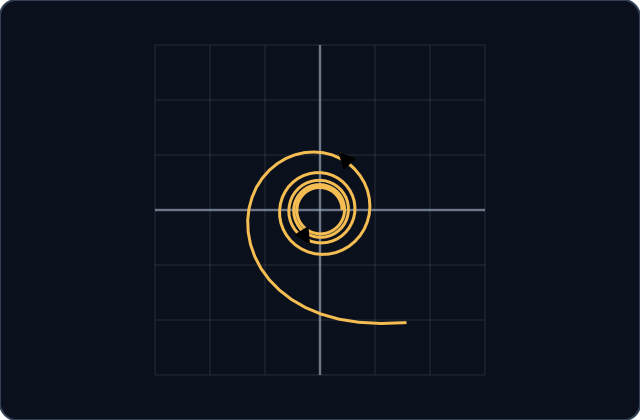
The same system with : the same Jacobian, the same linear centre, and every solution winds out. The linearisation cannot tell these two apart.
When the linearisation decides
Let be the Jacobian at an equilibrium of a system with continuous second derivatives. If every eigenvalue of has negative real part, the equilibrium is asymptotically stable; if some eigenvalue has positive real part, it is unstable. A saddle of is a saddle of the system, and nodes and spirals keep their type. When the eigenvalues are purely imaginary the linearisation decides nothing: the equilibrium may be a centre, a stable spiral or an unstable spiral. These are the theorems of Lyapunov and of Hartman and Grobman, used here without proof.
Deciding stability
- Pendulum with friction, , with : at the Jacobian has trace and determinant , so the rest position is asymptotically stable.
A linear centre decides nothing
The added terms are cubic, so their first derivatives vanish at the origin and every system of the family has the same Jacobian, a centre. Differentiate the squared distance from the origin: the rotation cancels, and the cubic terms leave a times r to the fourth. So the distance shrinks when a is negative and grows when a is positive — a stable and an unstable spiral with one and the same linearisation.
Proof steps
The cubic terms have zero first derivatives at the origin.
Differentiate r² = x² + y² and halve it.
The rotation terms cancel; the cubic ones remain.
So the distance falls for negative a and grows for positive a, while the linearisation is the same centre.
Applications
Practice
Real Parts Decide
All eigenvalues of the Jacobian with negative real part: asymptotically stable. One with positive real part: unstable. Purely imaginary: undecided.
Try it
The Jacobian at an equilibrium has eigenvalues . What is the equilibrium of the nonlinear system?
Try it
For the pendulum with friction, , , what is at ?
Try it
If the Jacobian at an equilibrium has purely imaginary eigenvalues, the equilibrium of the nonlinear system is a centre.
Try it
At the equilibrium of the pendulum, . What is it?
Try it
The Jacobian at an equilibrium is . What is its positive eigenvalue?
Try it
If one eigenvalue of the Jacobian has positive real part, the equilibrium is unstable, whatever the nonlinear terms.
Try it
The frictionless pendulum has a centre at its rest position. What does a little friction make of it?
Try it
For with and , what is at ?
Final checkpoint
Try it
Chapter two's test says an equilibrium of is stable when . How does it fit this lesson?
Try it
A spiral of the linearisation is a spiral of the nonlinear system near the equilibrium.
Try it
The Jacobian at an equilibrium has trace and determinant . What is the real part of its eigenvalues?
Completion
Lesson complete
Great work! You now know how to:
- decide stability from the eigenvalues of the Jacobian
- prove that a linear centre decides nothing
- see friction turn a centre into a stable spiral
- connect the test of chapter two to the Jacobian