Intuition
Most systems that matter are nonlinear: predators and prey, competing species, a pendulum swinging through large angles, reacting chemicals. Their equations rarely have formula solutions, but the phase plane still works: at each point the right-hand sides give a velocity, trajectories follow it, and they still never cross. What changes is that a nonlinear system can have several equilibria, each with its own local picture, and trajectories that run from one to another.
A landscape of hills and valleys instead of a single bowl or saddle. Water still flows downhill everywhere, but where it ends up depends on which valley it started in.
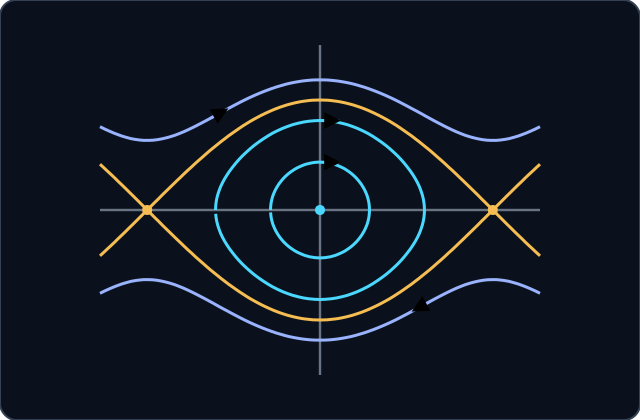
The pendulum , , angle across and angular velocity up. Near the rest position the trajectories are closed swings; the curves through the upside-down positions separate them from the motions that go over the top.
Rates that depend on the unknowns nonlinearly
An autonomous system , is nonlinear when or is not a linear combination of and . When , and their partial derivatives are continuous, the existence and uniqueness theorem still holds, so trajectories still never cross and the phase plane is read as in the linear chapter. What is new: several equilibria, closed orbits that are not ellipses, and trajectories that run from one equilibrium to another.
What changes, and what does not
- The pendulum is the system , , nonlinear because of the sine.
The pendulum conserves its energy
Differentiate the energy along a solution. The chain rule gives omega times its derivative plus the sine times the derivative of theta; substituting the equations, the two terms are equal and opposite. The energy is therefore constant, and every trajectory lies on one of its level curves: closed loops for small energy, the swings, and wavy lines for large energy, the pendulum going over the top.
Proof steps
Kinetic energy plus potential energy, in suitable units.
Differentiate along a solution by the chain rule.
Substitute the two equations.
So each trajectory stays on one level curve of the energy.
Applications
Practice
Nonlinear Means a Product or a Curve
A system is nonlinear when a rate involves a product of the unknowns, a power of one, or a function such as a sine of them.
Try it
Which system is nonlinear?
Try it
For the pendulum , , what is the energy of the solution through ?
Try it
Two trajectories of , can cross.
Try it
A pendulum trajectory has energy . What does the pendulum do?
Try it
, . At what time does the solution become infinite?
Try it
Every trajectory of the frictionless pendulum lies on a level curve of its energy.
Try it
On the curve where , how do trajectories cross it?
Try it
For , , what is at ?
Final checkpoint
Try it
What can a nonlinear system in the plane have that a linear system cannot?
Try it
Every solution of a system with smooth right-hand sides exists for all time.
Try it
How many equilibria does the pendulum , have with ?
Completion
Lesson complete
Great work! You now know how to:
- recognise a nonlinear system
- prove that the pendulum conserves its energy
- read swings and motions over the top from the energy
- say what the linear theory keeps and what it loses