Intuition
An equilibrium of a nonlinear system is a point where both rates vanish at once, and finding them all is algebra: solve the two equations together. The curves where each rate vanishes, the nullclines, cross exactly at the equilibria, and they also cut the plane into regions where the direction of motion is roughly known: right or left, up or down. Before anything is solved, the nullclines give a rough map of the flow.
Two roads on a map. Where they cross is a junction; the roads also split the country into districts, and in each district the traffic is known to flow one way.
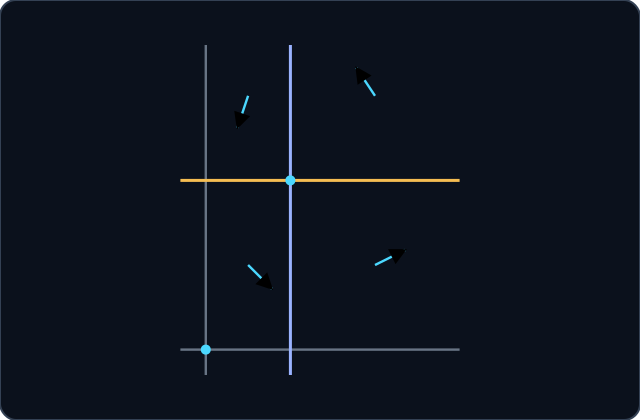
, . The nullclines , where , and , where , cross at the equilibrium ; with the axes, where the rates also vanish, they cut the quadrant into four regions. The arrows give the direction of motion in each: round the equilibrium, anticlockwise.
Solve both rates at once
A point is an equilibrium of , when and both vanish there; the constant pair sitting there is a solution. The -nullcline is the curve , where motion is vertical, and the -nullcline is , where it is horizontal; the equilibria are exactly their crossings. Between nullclines the signs of and are fixed, and so is the rough direction of motion.
Finding them
- , : on or , and on or . The crossings are and .
Between the nullclines the direction is fixed
Suppose f were positive at one point of the region and negative at another. Join them by a path inside the region. Along the path f is a continuous function of one variable that changes sign, so by the intermediate value theorem it vanishes somewhere on the path — at a point of the region, where f was assumed never to vanish. So f keeps one sign, and the horizontal direction of motion is the same throughout the region; the same holds for g.
Proof steps
Suppose the sign changed between two points of the region.
Join them by a path inside the region, which is in one piece.
By the intermediate value theorem, f vanishes somewhere on the path.
But f never vanishes in the region: so it has one sign throughout.
Applications
Practice
Both Rates Zero
Solve f = 0 and g = 0 together. Factor each, and pair a factor of one with a factor of the other.
Try it
What are the equilibria of , ?
Try it
How many equilibria does , have?
Try it
On the curve , trajectories of , move vertically.
Try it
For , , which way does a trajectory move at ?
Try it
, . Apart from the origin there is one more equilibrium. What is its -coordinate?
Try it
For , , the point is an equilibrium.
Try it
Why is the direction of motion roughly fixed inside a region bounded by nullclines?
Try it
For , , what is the -coordinate of the first equilibrium with ? Give two decimal places.
Final checkpoint
Try it
How many equilibria does , have?
Try it
A trajectory that is not an equilibrium can arrive at an equilibrium of a nonlinear system at a finite time.
Try it
For , , trajectories below move right, to its right up, above it left and to its left down. Which way do they go round it?
Completion
Lesson complete
Great work! You now know how to:
- find the equilibria of a nonlinear system
- draw the nullclines and the direction of motion between them
- prove that the direction is fixed between nullclines
- read the rough flow before solving anything