Intuition
Rabbits multiply when foxes are scarce, foxes thrive when rabbits are plentiful, and each population drags the other through cycles. The Lotka–Volterra equations make this precise with two products — the encounters between the species — and their phase portrait is a family of closed orbits around a coexistence equilibrium. The linearisation there is a centre, which decides nothing, but the system has a conserved quantity that closes every orbit.
The fur records of the Hudson’s Bay Company, which bought lynx and hare pelts for a century: the numbers of the two animals rose and fell in cycles of about ten years, the lynx peaks following the hare peaks.
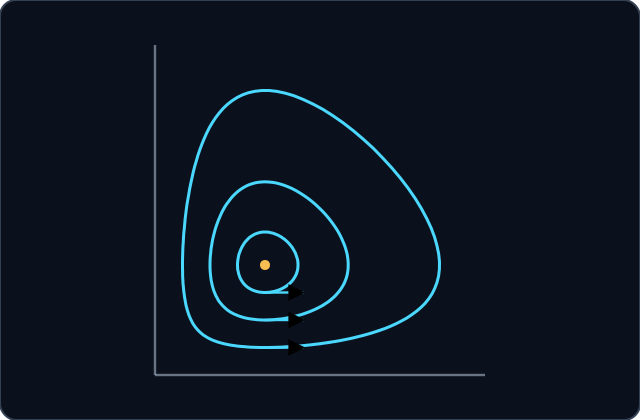
, , prey across and predators up. Every orbit around the coexistence point is closed and runs anticlockwise: the prey grow, the predators follow, the prey collapse, the predators starve, and the cycle repeats.
The Lotka–Volterra equations
With the prey and the predators, and , all four constants positive: prey grow at rate on their own and are eaten at a rate proportional to encounters, ; predators die at rate on their own and grow by eating. The equilibria are , a saddle, and the coexistence point , where the linearisation is a centre. The quantity below is conserved, so every orbit in the positive quadrant is a closed curve: the populations cycle for ever.
What the model says
- , : equilibria and ; at the Jacobian is , a centre.
The orbits are closed
Differentiate V along a solution. The factor multiplying x′ is d − c/x, and x′ is x times a − by, so their product is dx − c times a − by. The same computation for y gives by − a times dx − c. These are equal and opposite, so V never changes: each orbit lies on a level curve of V, and the level curves around the coexistence point are closed.
Proof steps
Differentiate V along a solution.
Since x′ = x(a − by).
Since y′ = y(dx − c).
The two products are equal and opposite.
Applications
Practice
Encounters Are Products
Predators eat prey at a rate proportional to how often they meet, and that is the product of the two populations.
Try it
In , , what does the term describe?
Try it
For , , what is the prey level at the coexistence equilibrium?
Try it
Every solution of the Lotka–Volterra equations starting with both populations positive is periodic, apart from the equilibrium itself.
Try it
What kind of equilibrium is for , ?
Try it
For , , what is the average predator population over one cycle?
Try it
The Jacobian alone proves that the orbits around the coexistence equilibrium are closed.
Try it
Moderate fishing removes a fixed fraction of both prey and predator fish. What happens to the averages?
Try it
For , , the conserved quantity is . What is at the equilibrium ?
Final checkpoint
Try it
In a predator–prey cycle, which population peaks first?
Try it
Adding a crowding term to the prey equation keeps the orbits closed.
Try it
For , , what is , the derivative of in , at ?
Completion
Lesson complete
Great work! You now know how to:
- build the Lotka–Volterra model from encounters
- prove that it conserves a quantity and that its orbits close
- read the averages and the effect of harvesting
- say why a centre of the Jacobian is not enough here