Intuition
Two species eating the same food hold each other back as well as themselves. Each alone would settle at its carrying capacity, as in the logistic model; together, the outcome depends on how strongly each crowds the other compared with how strongly it crowds itself. Weak competition lets them coexist at a stable equilibrium; strong competition makes coexistence a saddle, and one species drives the other out — which one depends on where they start.
Two shops on one street selling the same goods. If each has its own loyal customers, both survive; if every customer buys purely on price, the first to gain an edge takes the whole street.
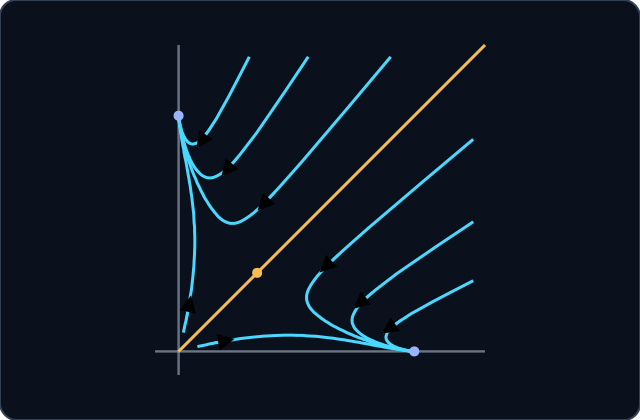
Strong competition, , . The coexistence point is a saddle; starts below the diagonal end with alone at and starts above it with alone at .
Crowding each other
and with : each species alone grows logistically to , and and measure how much each crowds the other. The equilibria are , , and, when it lies in the quadrant, the coexistence point below. If and it is a stable node and the species coexist; if and it is a saddle, and one species wins, decided by which side of the separatrix the start lies.
Weak and strong competition
- : coexistence at , where the Jacobian has eigenvalues and : a stable node.
Where the coexistence point lies
Away from the axes, each species is at rest on a straight nullcline. Substituting the first line into the second gives a linear equation for y, solved when αβ is not 1; the first line then gives x. Both coordinates are positive exactly when the two numerators have the sign of the denominator, which happens when α and β are both below one or both above.
Proof steps
Away from the axes, both species are at rest on their nullcline lines.
Substitute the first into the second.
Solve for y, then use the first line for x.
Both are positive exactly when the two crowdings lie on the same side of one.
Applications
Practice
Crowding Coefficients
α measures how much species y holds back species x, compared with how much x holds itself back.
Try it
In , , what does measure?
Try it
For , what is at the coexistence equilibrium? Give three decimal places.
Try it
When and , the two species coexist at a stable equilibrium.
Try it
For , what happens in the long run to a start with both species present?
Try it
For the Jacobian at is . What is its positive eigenvalue? Give three decimal places.
Try it
For , a solution starting on the line stays on it.
Try it
For , the populations start at . Which species wins?
Try it
At the Jacobian is . For , what is its second eigenvalue?
Final checkpoint
Try it
What is the principle of competitive exclusion, in the language of this lesson?
Try it
When , the coexistence point lies in the positive quadrant.
Try it
If species is absent, what value does approach in from ?
Completion
Lesson complete
Great work! You now know how to:
- model two competing species
- derive where the coexistence point lies
- tell weak competition from strong by the Jacobian
- predict the winner from the start and the separatrix