Intuition
Put the pieces together and a nonlinear portrait can be drawn without solving anything. Find the equilibria, classify each through its Jacobian, draw the nullclines and the direction of motion between them, and connect: trajectories leave one equilibrium along its unstable directions and arrive at another. The curves that separate different long-run fates — the separatrices — run into the saddles along their stable directions.
Mapping a river basin from a few surveyed points: the springs, the lakes and the passes. Once they are placed, the rivers can be sketched between them, and the watersheds run over the passes.
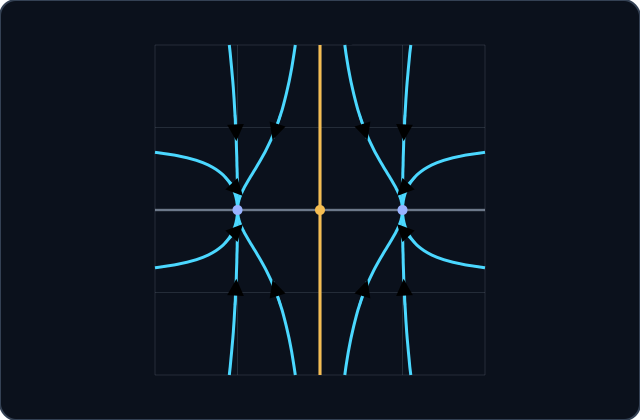
, : stable nodes at and a saddle at the origin. Every start to the right of the vertical axis ends at , every start to its left at ; the axis itself, the saddle's stable direction, is the separatrix between the two basins.
From equilibria to a whole picture
To sketch the portrait of , : find every equilibrium; classify each by the eigenvalues of its Jacobian, drawing the eigenvector directions of saddles and nodes; draw the nullclines and mark the direction of motion between them; then join the pieces, using that trajectories never cross. The stable directions of a saddle continue as separatrices, which divide the plane into basins of attraction: the sets of starting points that end at the same equilibrium.
Joining the pieces
- , : equilibria , and . The Jacobian gives stable nodes at and a saddle at .
Which basin a start belongs to
The two equations are decoupled. The second makes y decay to zero whatever happens. The first is an autonomous equation in x alone, whose phase line has equilibria at −1, 0 and 1, and to the right of zero it points towards 1 from both sides. So every start with positive x ends at (1, 0), every start with negative x at (−1, 0), and the vertical axis, which stays put, separates the two basins.
Proof steps
The second equation is decoupled, and its solutions decay.
The first is autonomous: a phase line, as in chapter two.
Between its equilibria the sign is fixed.
So every positive start moves monotonically to the stable equilibrium at 1.
Applications
Practice
The Recipe
Equilibria first, then their Jacobians, then the nullclines with directions, and finally join the pieces without crossing.
Try it
What is the first step in sketching a nonlinear phase portrait?
Try it
How many equilibria does , have?
Try it
For , , the solution starting at ends at .
Try it
What is the equilibrium of , ?
Try it
For , , a solution starts at . What does approach?
Try it
A trajectory can pass from the basin of one stable equilibrium into the basin of another.
Try it
What is a separatrix?
Try it
For , , what is at ?
Final checkpoint
Try it
A trajectory leaves a saddle along one of its unstable directions. Where can it end?
Try it
A good phase portrait of a nonlinear system can be sketched without solving its equations.
Try it
The pendulum with friction , is drawn for . How many resting positions , each with its own basin, lie in that range?
Completion
Lesson complete
Great work! You now know how to:
- sketch a nonlinear phase portrait in four steps
- find the basins of attraction and the separatrices between them
- prove which basin a start belongs to
- say where a trajectory leaving a saddle can end