Intuition
Open sets combine freely in one direction and only sparingly in the other. Any number of them may be united and the result is open. Only finitely many may be intersected.
Any number of overlapping areas of coverage still leaves you covered somewhere. Demanding that infinitely many conditions hold at once can squeeze the room away completely.
Combining open sets
A union of any collection of open sets is open, however large that collection. An intersection of finitely many open sets is open. An intersection of infinitely many need not be, and this is not a gap in the argument but a fact about the subject: it is why the next chapter takes exactly these two rules as its starting point.
Why the two directions differ
- For a union, a point lies in at least one member, and that member already supplies a ball.
- For a finite intersection, the smallest of finitely many positive radii is still positive.
- For an infinite intersection there may be no smallest radius, and the room can shrink to nothing.
- : each interval is open and the intersection is not.
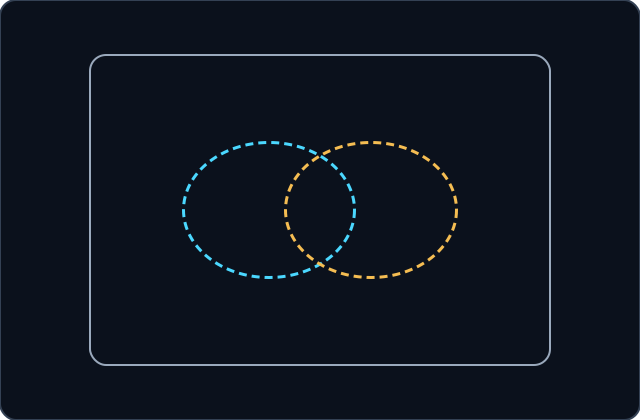
Everything inside either ring is open, and that holds for any number of open sets at once, however many. Intersecting is the direction needing care: only finitely many may be met, because an endless shrinking sequence of them can close the result up.
A union of open sets is open
Take a point of the union. Belonging to a union means belonging to at least one of the members, and that member is open, so it hands over a ball around the point. A ball inside one member is inside the union as well, because a member is part of it. The size of the collection never enters the argument, which is why it may be infinite.
Proof steps
Take any point of the union; the condition for openness has to be checked there.
Belonging to a union means belonging to at least one of its members. Fix one and call it .
That member is open, so it supplies a ball around the point lying inside it.
A subset of one member is a subset of the union, so the condition holds at this arbitrary point.
Applications
Practice
Unions have no size limit
Infinitely many open intervals, and the union is open.
Try it
How many open sets may be united with the result still open?
Finitely many radii have a smallest
This step is exactly where finiteness is used.
Try it
Why is an intersection of finitely many open sets open?
Infinitely many can squeeze it out
Every interval is open; the intersection is a single point, which is not.
Try it
Is an intersection of infinitely many open sets always open?
Two is finite
Two open intervals, and the overlap is open.
Try it
On the real line, is open?
Try it
Which combination of open sets is guaranteed to be open?