Intuition
Any subset of a metric space is a metric space in its own right: keep the same distance rule and simply stop asking about points outside. What changes is not the distances but the balls — and with them which sets count as open, because a ball of the subset is only the part of the old ball that survived.
Measure distances in a town with the same tape measure you used for the county. Nothing about the tape changes when you stop walking outside the town boundary, but a circle drawn around a house at the edge is now a circle with a piece missing.
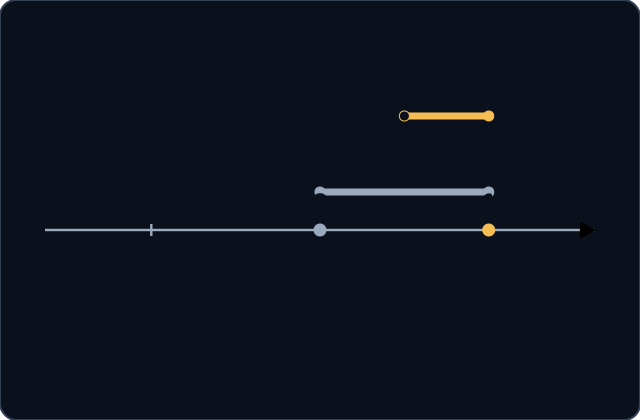
The space here is , with the metric of the line. The ball is everything in within of , which is — the trace on of the interval . It contains its right-hand end, and in it is open, although as a subset of it is not.
The induced metric
Let be a metric space and any subset. Restricting to pairs of points of gives a metric on , called the induced metric, and is a subspace of . The three conditions are inherited unchanged, because each of them is a statement about particular points and those points are still there.
What is inherited and what is not
- The three conditions on a metric pass to every subset, so no checking is needed: a subset of a metric space is a metric space.
- A ball of the subspace is the trace of a ball of the whole space, which the theorem below proves. Every question about can therefore be answered by intersecting with .
- Openness is not inherited in the same way: is open in , because it is the ball , and it is not open in . Open is always open in a stated space, and the space has to be named.
The balls of a subspace are the traces of balls
Both sides are sets of points of A within r of a, so the proof is a matter of reading each side. A point of the left-hand side lies in A and satisfies the distance condition, so it lies in the ball of X and in A. A point of the right-hand side lies in A and satisfies the same condition, because the induced metric gives it the same distance. Nothing deeper happens: the induced metric was defined to make this true.
Proof steps
Unfold the ball of the subspace: its points come from A and satisfy the distance condition there.
The induced metric is the old one restricted, so the distance is unchanged.
The same two conditions describe the trace on A of the ball of X.
The two sets have the same members, so they are equal.
Applications
Practice
Same Rule, Fewer Points
A subset becomes a metric space by keeping the distance rule and forgetting the rest of the space. No condition needs rechecking.
Try it
Why is every subset of a metric space a metric space?
Try it
In with the metric of the line, what is ?
Open In What?
Openness is always relative to a space. A set can be open in a subspace and not in the whole space.
Try it
is open in the space .
Try it
is open in .
Try it
Let with the metric of the line. How many points does contain?
Try it
A sequence of points of converges in the subspace exactly when what happens in ?
Try it
What does the induced metric on do to balls of small radius?
Try it
A subspace of a complete metric space is complete.
What You Learned
- A subset with the restricted metric is a metric space, the subspace.
- : the balls are traces.
Final checkpoint
Try it
In the subspace of , what is ?
Try it
Whether a set is open can depend on which space it is regarded as sitting in.
Completion
Lesson complete
Great work! You now know how to:
- form the induced metric on a subset;
- compute balls in a subspace as traces of balls;
- give a set open in a subspace and not in the whole space;
- say which properties a subspace inherits and which it does not.