Intuition
A sequence converges to a point when its terms end up inside every ball around that point, however small the ball is asked to be. Only the distance is used, so the definition reads the same in the plane, in a space of functions and in a set with the discrete metric — and the answers differ wildly.
A plane approaching an airport is eventually inside every circle you care to draw around it: within ten miles, then within one, then within a hundred metres. The circles are yours to choose; the aircraft has to satisfy all of them.
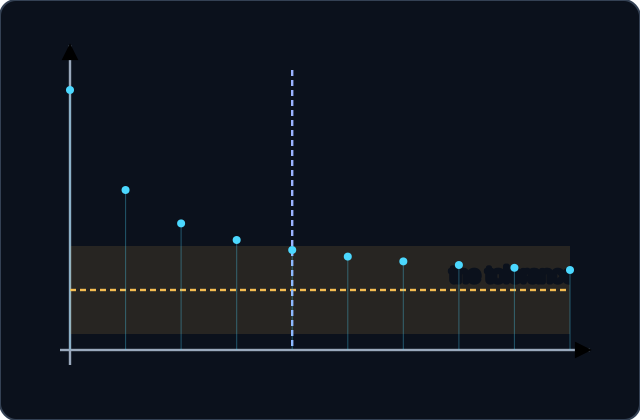
The terms of against their index, with a band of half-width about the limit . From the fifth term on, every term is inside the band; that is what the marks. Shrink the band and the mark moves right, but a mark can always be found — which is exactly what convergence asks.
Convergence in a metric space
Let be a metric space and a sequence of its points. The sequence converges to when the distances can be forced below any tolerance by going far enough along the sequence. We write , and call the limit.
Reading the definition
- The tolerance comes first and the index second: is allowed to depend on , and it always does. A smaller buys a larger .
- Every term from on must be inside the ball . So convergence says: each ball about contains all but finitely many terms of the sequence.
A limit is unique
Suppose the sequence had two different limits. Their distance apart is a positive number, so half of it is a tolerance the definition must meet for both of them at once. Beyond some index every term is within that half of the first limit and within that half of the second, and then the triangle inequality makes the distance between the two limits smaller than itself. That is impossible, so the two limits were never different.
Proof steps
Assume two different limits and take half their distance apart as the tolerance; it is positive because the points differ.
The definition applied to the first limit gives an index beyond which the terms are that close to x.
The same definition applied to the second limit gives another index.
Take any n beyond both indices and go from x to y through that term.
But twice the tolerance is the distance itself, so the distance is smaller than itself. The assumption that the limits differ has to go.
Applications
Practice
Every Tolerance, Eventually
Convergence asks for one thing for every positive : an index beyond which the terms stay within of the limit.
Try it
Which statement says that ?
Try it
For on and , what is the smallest with for every ?
Convergence Under the Discrete Metric
Take . The only points within of are itself, so the terms beyond must all equal .
Try it
On a set with the discrete metric, which sequences converge?
Try it
Changing the first thousand terms of a convergent sequence can change its limit.
Try it
A convergent sequence in a metric space stays inside some ball.
Try it
Which phrase says the same as ?
Try it
A reader argues: " converges to , because for every there are terms within of ." Where does the argument go wrong?
Try it
In with the Euclidean metric, the sequence converges. What is the second coordinate of its limit?
What You Learned
- means: for every there is an with for all .
Final checkpoint
Try it
A sequence in a metric space can converge to two different points.
Try it
A sequence satisfies: for every there is an with for all . Which decides whether the sequence is eventually equal to in a discrete space?
Completion
Lesson complete
Great work! You now know how to:
- state convergence in a metric space and read its quantifiers in order;
- find an for a given ;
- use that a limit is unique and depends only on the tail;
- say what convergence means under the discrete metric.