Intuition
Convergence names a limit. There is a weaker demand that names nothing: that the terms eventually get close to each other. A sequence whose terms huddle together like this is called Cauchy, and it is what you can check when the limit is exactly the thing you are trying to find.
A search party closing in reports that its members are all within fifty metres of each other. That is progress, and it is checkable on the radio — without anyone knowing yet whether there is anything at the middle to find.
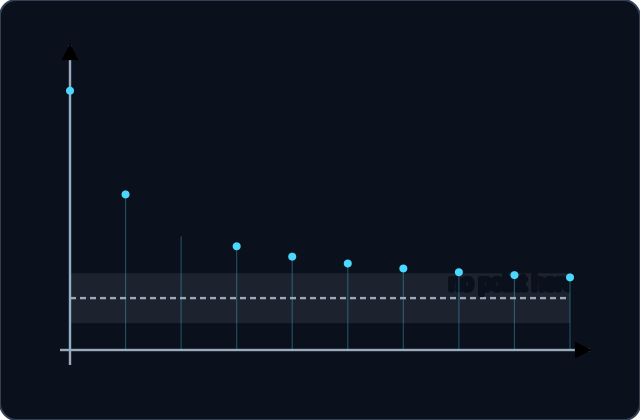
The sequence inside the space , where the point is missing. The terms crowd together — beyond the tenth they are all within of each other — and there is nothing in the space for them to crowd around. Being Cauchy is about the terms; converging is about the space as well.
Close to each other, eventually
A sequence in a metric space is Cauchy when for every tolerance there is an index beyond which any two terms are within that tolerance of each other. The limit does not appear: the condition compares terms with terms.
What it does and does not say
- Every convergent sequence is Cauchy, which the theorem below proves. The converse is the interesting direction, and it depends on the space.
- In the sequence is Cauchy and converges to nothing: its only candidate limit, , is not a point of the space. In the sequence is Cauchy and has no rational limit.
Convergent sequences are Cauchy
Given a tolerance, apply the definition of convergence to half of it. Beyond the index it provides, every term is within half the tolerance of the limit. Two such terms are then within a tolerance of each other, by going from one to the other through the limit. Halving first is what makes the triangle inequality come out right, and it is the standard move.
Proof steps
Take any tolerance and halve it; half of a positive number is again a tolerance the definition of convergence must meet.
Convergence gives an index beyond which every term is that close to the limit.
Take any two indices beyond it; the claim is about this pair.
Travel from one term to the other through the limit and use the two bounds.
The two halves make one tolerance, which is what being Cauchy asks for.
Applications
Practice
Terms Against Terms
The Cauchy condition compares two late terms with each other. No limit appears in it, which is why it can be checked without knowing one.
Try it
Which condition says that a sequence is Cauchy?
A Warning Worth Remembering
For , consecutive terms are as close as you like: .
Try it
Why is not Cauchy, although ?
Try it
Every convergent sequence in a metric space is Cauchy.
Try it
Every Cauchy sequence in a metric space converges.
Try it
For on and , what is the smallest with for all ?
Try it
In with , what is true of ?
Try it
A Cauchy sequence is bounded.
Try it
Which sequences are Cauchy in a set with the discrete metric?
Final checkpoint
Try it
A sequence satisfies . What is the smallest that meets the tolerance ?
What You Learned
- A sequence is Cauchy when its terms eventually stay within any tolerance of each other.
- Convergent sequences are Cauchy; the converse depends on the space.
- Consecutive gaps tending to is not enough — remember .
Try it
Deciding whether a sequence is Cauchy requires knowing its limit.
Completion
Lesson complete
Great work! You now know how to:
- state the Cauchy condition and tell it from convergence;
- prove that a convergent sequence is Cauchy;
- give a Cauchy sequence that converges to nothing;
- reject the argument that consecutive terms closing up is enough.