Intuition
A space is complete when every sequence that tries to converge succeeds — that is, when every Cauchy sequence has a limit inside the space. Completeness is what separates the real line from the rationals, and it is the property everything that approximates depends on.
A road is complete if every journey that slows to a halt actually stops somewhere on the road. The rationals are a road with pinpricks missing: you can drive towards a hole and never arrive.
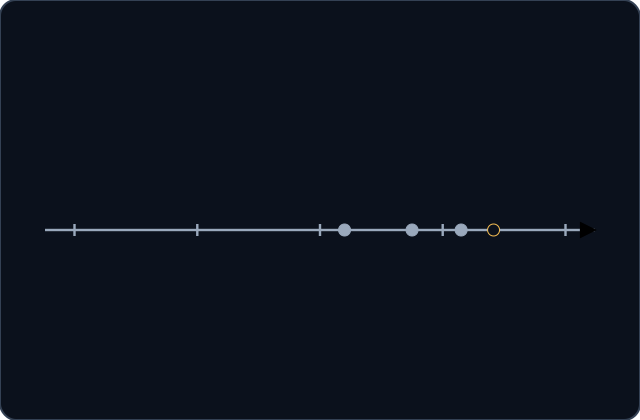
Rational approximations of — , then , then — drawn spread out, since at true scale all three would sit inside the hollow point. Each is a point of ; the point they close in on is hollow, because it is not one. In the same sequence has its limit and the space is complete; in the sequence is Cauchy and converges to nothing.
Completeness
A metric space is complete when every Cauchy sequence of its points converges to a point of the space. The previous lesson gave the two halves of this: convergent sequences are always Cauchy, and Cauchy sequences are not always convergent. Completeness is the name for spaces where the two classes coincide.
Which spaces are complete
- with is complete. This course takes it on trust: the proof needs the least upper bound property, which belongs to the analysis course, and a prerequisite cannot cross a course.
- is not complete, and neither is : each has a Cauchy sequence whose only candidate limit is missing.
A Cauchy sequence with a convergent subsequence converges
The subsequence gets close to the limit and the whole sequence gets close to itself, so any late term can be joined to the limit through a term of the subsequence. Halve the tolerance twice over: once for the Cauchy condition and once for the subsequence, then pick an index of the subsequence lying beyond both. This is the argument that makes sequential compactness worth having later: finding one convergent subsequence is then enough.
Proof steps
Apply the Cauchy condition to half the tolerance.
Apply convergence of the subsequence to the same half.
The indices of a subsequence increase without bound, so one of them lies beyond N as well.
For any n beyond N, travel to the limit through that term of the subsequence.
Every tolerance has been met from an index on, which is convergence of the whole sequence.
Applications
Practice
No Cauchy Sequence Left Behind
Complete means: being Cauchy is already enough to converge, with the limit in the space.
Try it
What does it mean for a metric space to be complete?
Try it
Which of these metric spaces is not complete?
Try it
with is complete.
Try it
If a Cauchy sequence has a subsequence converging to , then the whole sequence converges to .
Try it
Why does this course not prove that is complete?
Try it
In , how many terms of are within of ? Count the terms listed.
Try it
is complete and sits inside it. What does that say about completeness?
Try it
A map of a metric space to itself with produces a Cauchy sequence from any starting point by repeated application.
What You Learned
- Complete: every Cauchy sequence converges, with its limit in the space.
- , , and every discrete space are complete; and are not.
Final checkpoint
Try it
Which sequence shows that is not complete?
Try it
In a complete metric space, a sequence converges if and only if it is Cauchy.
Completion
Lesson complete
Great work! You now know how to:
- define a complete metric space;
- name complete and incomplete spaces and justify each;
- use that a Cauchy sequence with a convergent subsequence converges;
- say which fact about the reals this course takes on trust and why.