Intuition
Once there is a distance, the natural thing to collect is every point closer to a chosen point than some fixed amount. That collection is called a ball, and it is the basic shape of the whole subject.
Everywhere within twenty minutes of a station is a ball around it. Its shape on a map depends entirely on how the twenty minutes are measured.
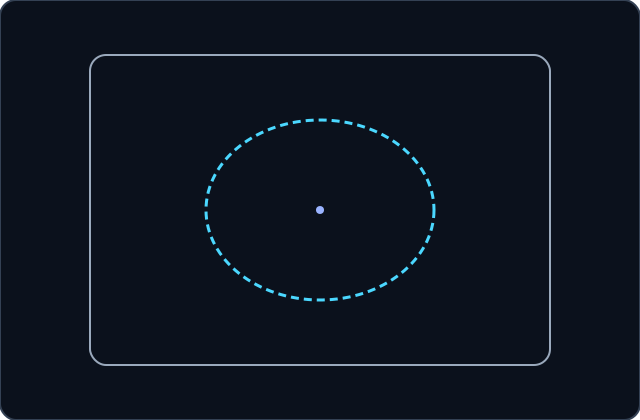
Every point closer to than , and nothing else. The edge is drawn dashed because it is not included: a ball is the strict , and that strictness is what makes it behave like an open set rather than a closed disc.
Balls around a point
For a point of a metric space and a real number , the open ball of centre and radius is the set of points strictly closer to than . The radius must be positive: with the collection would be empty, since no point is at distance less than zero. The inequality is strict, which is what the word open is doing here.
What a ball contains
- for every , because .
There is room inside a ball
Take a point of the ball. It is strictly nearer the centre than the radius, so there is some room left over, and measures it. Any point within that much of the chosen point reaches the centre by a detour costing less than the radius, so it lies in the original ball. This one fact is what the next lesson is built on.
Proof steps
The point lies in the ball, so its distance to the centre is strictly less than the radius and the leftover room is positive.
Take any point of the smaller ball, so its distance to is less than .
Reach from the centre by way of , using the triangle inequality.
The second term is smaller than , and was chosen to make the total exactly the radius.
The distance from the centre is strictly less than the radius, which is what belonging to the ball means. This holds for every such .
Applications
Practice
Strictly closer than the radius
on , holds 1.9 but not 2
The distance from 0 to 2 is 2, which is not less than 2.
Try it
On the real line with , which number lies in ?
A ball always holds its centre
True for every positive radius, in every metric space.
Try it
Can an open ball be empty?
The shape depends on the metric
for , so
No other point is strictly closer than 1, because every other point is at exactly 1.
Try it
On a set with the metric giving 1 to every pair of different points, what is ?
Room left over
,
Then fits inside , by the triangle inequality.
Try it
On the real line, lies in . Which radius does the theorem give for a ball around 4 staying inside?
Try it
Why must the radius of an open ball be strictly positive?
Closed Balls
Swapping for in the definition gives the closed ball, which adds the points at exactly the radius.
Try it
On the real line, what is ?
Try it
In a set of at least two points with the discrete metric, what is the closed ball ?
Try it
In with the taxicab metric, how many points lie in ?
Try it
On the real line with the usual metric, the closed ball of radius holds exactly two points that the open ball of the same radius does not.