Intuition
Near a classical turning point the WKB formulas blow up, but there the potential is nearly a straight line, and the Schrödinger equation in a linear potential is solved exactly by the Airy function. Far from the turning point on either side, the Airy function turns into a WKB wave: an oscillation on the allowed side and a decay on the forbidden side, joined with a definite phase of . These connection formulas let WKB solutions be carried across turning points, and so give energy levels and tunnelling rates.
A road crossing a river needs a bridge built for the crossing itself; on each bank the ordinary road continues. The Airy function is the bridge at a turning point, and the connection formula says how the roads on the two banks line up.
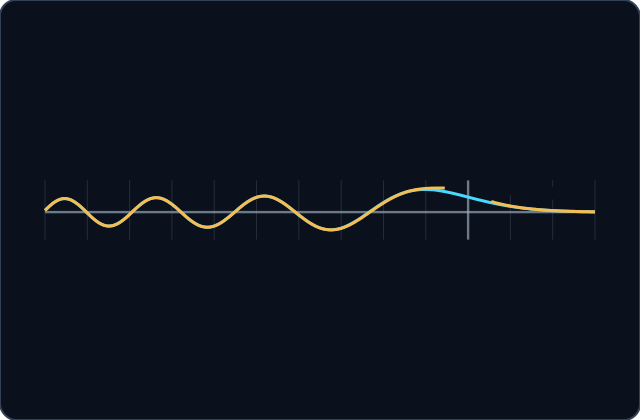
Near a turning point, at , the exact solution in a linear potential is the Airy function (solid). Away from it on either side the WKB forms (dashed) match it — an oscillation with phase on the allowed side, a decay on the forbidden side — and both blow up near the turning point itself.
Connection formulas
For a turning point at with the allowed region on the left, the decaying WKB solution on the right continues into the oscillating one on the left with a phase of .
Properties
- Near the potential is , and the Schrödinger equation becomes the Airy equation in a scaled variable .
Where the connection formula comes from
Straighten the potential near the turning point and rescale the variable: the equation becomes Airy’s. The solution that decays into the forbidden region is . Its known asymptotic forms on both sides are exactly the two WKB expressions of the connection formula.
Proof steps
With , , the equation near the turning point.
Rescaling removes every constant: Airy’s equation.
Of the two solutions, is the one that decays for , into the forbidden region.
The asymptotic forms of the Airy function, quoted without proof.
In the linear region the Airy phases are the WKB integrals, which gives the connection formula.
Applications
Practice
A Straight Line Near the Turn
Close to a turning point the potential can be replaced by its tangent line. The Schrödinger equation in a linear potential is solved exactly by the Airy function.
Try it
Why does the Airy function appear at turning points?
A Quarter of \pi
Carried across a turning point from the forbidden side, the oscillating WKB solution has the phase subtracted from its integral.
Try it
What phase, in radians, appears in the connection formula at a smooth turning point? Give three decimal places.
Which Way It Is Used
A solution decaying into the forbidden region fixes the oscillating solution on the allowed side. A growing piece in the forbidden region would be hidden by the decaying one, so the formula is used in that direction.
Try it
On the forbidden side of a turning point, the physical solution for a bound state decays away from the turning point.
The Airy Function
decays on the right and oscillates on the left, with growing frequency and shrinking amplitude as becomes more negative.
Try it
The asymptotic form gives the zeros of where . What is the first zero predicted, ? Give two decimal places.
Try it
Near a turning point, what does the Schrödinger equation reduce to?
Try it
With and slope , what is the scale of the Airy variable?
Try it
At an infinitely hard wall the phase in the corresponding formula is also .
Final checkpoint
Try it
A bound state has two smooth turning points. How much phase, in units of , do the two connection formulas add together?
Try it
What is the WKB form of the solution far on the allowed side of a turning point at ?
Try it
The connection formula follows from the asymptotic forms of the Airy function on the two sides of the turning point.
Completion
Lesson complete
Great work! You now know how to:
- reduce the equation at a turning point to Airy’s
- state and use the connection formula
- explain the phase of a smooth turning point