Intuition
When a potential changes little over one wavelength, the wavefunction looks locally like a plane wave with the local momentum . Its phase advances by , and its amplitude changes too: probability piles up where the particle moves slowly, so the amplitude goes as . This is the WKB approximation, named after Wentzel, Kramers and Brillouin. It is the bridge between quantum and classical mechanics, and it fails exactly where a classical particle would turn back.
A car travelling through a town spends more time on the slow streets than on the fast ones; a photograph taken at a random moment most likely shows it on a slow street. The WKB amplitude is that photograph’s probability.
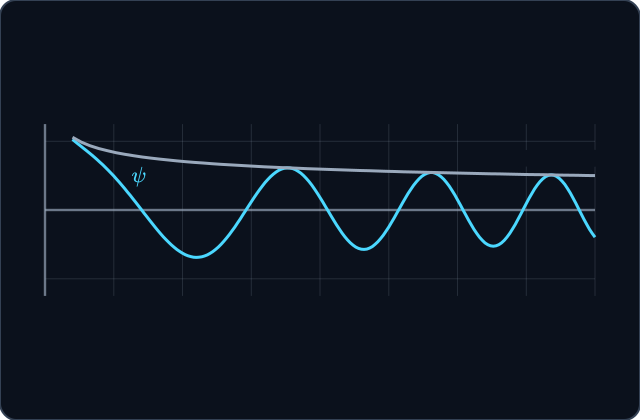
A WKB wave in a potential that falls steadily, at with : as the particle speeds up its wavelength shortens, and its amplitude, following , shrinks — it spends less time where it moves faster.
The WKB approximation
Where , the local momentum is . When changes slowly on the scale of a wavelength, the solutions are approximately the two below; where , becomes imaginary and they grow or decay.
Properties
- Validity: the local wavelength changes little over one wavelength, .
- : the probability density follows the time a classical particle spends at each place.
Deriving the WKB form
Write the wavefunction as an exponential of a phase and put it into the Schrödinger equation. Order by order in : the leading order says the phase’s slope is the classical momentum; the next says how the amplitude must change to conserve probability.
Proof steps
Put into .
The terms without : the phase advances by the classical action.
The terms with one power of .
Integrate and exponentiate.
Keeping the first two orders; the next is small when .
Applications
Practice
Amplitude as 1/\sqrt{p}
The WKB amplitude goes as one over the square root of the local momentum, so the probability density goes as one over the speed: large where the particle is slow.
Try it
Where is the WKB probability density of a particle in a well largest?
Local Momentum
Where the energy exceeds the potential, the particle has a local momentum , and a local wavelength .
Try it
With , and at some point, what is the local momentum there? Give three decimal places.
Where It Fails
At a classical turning point the local momentum is zero, so the WKB amplitude blows up. The approximation fails there and must be patched.
Try it
The WKB approximation is most accurate at the classical turning points.
Comparing Densities
Since the density goes as , a place where the particle is twice as fast has half the density.
Try it
At point the local momentum is 3, at point it is 1. What is the ratio in the WKB approximation?
Try it
When is the WKB approximation valid?
Try it
With and a constant local momentum across a region of width , by how many radians does the WKB phase advance across it? Give three decimal places.
Try it
The leading term of the WKB phase is the classical action divided by .
Final checkpoint
Try it
With , a particle of energy 1 enters a region where . What is there, which sets the WKB decay rate?
Try it
In what sense is WKB an approximation?
Try it
In the WKB approximation, how many times more probable per unit length is a particle where its speed is 2 m/s than where it is 8 m/s?
Completion
Lesson complete
Great work! You now know how to:
- derive the WKB wavefunction from an expansion in
- relate its amplitude to the classical time spent
- judge where the approximation holds and where it fails