Intuition
Under a barrier the WKB solution decays, and across the forbidden region its amplitude falls by the exponential of the integral of . The transmission is the square of that: an exponential of twice the integral, the Gamow factor. For a rectangular barrier it gives back the of the chapter on one dimension; for a real barrier of changing height it gives what that chapter could not — the rates of alpha decay, of field emission from a metal tip, of nuclear fusion in the Sun.
Light through a thick fog fades exponentially with the depth of fog it crosses; where the fog is thicker it fades faster. A particle under a barrier fades the same way, with playing the fog’s thickness.
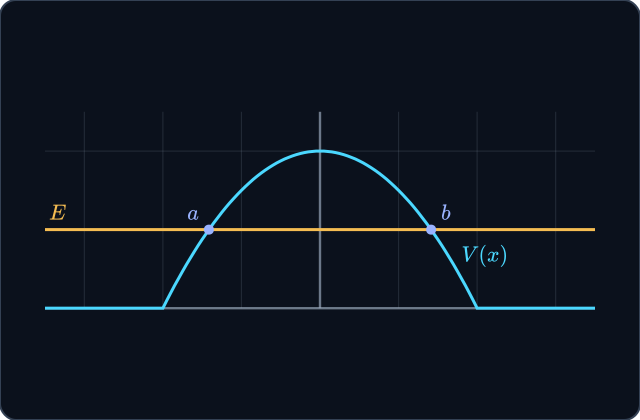
A barrier and an energy below its top, with . Between the turning points and the particle is classically forbidden; WKB gives .
Tunnelling through a smooth barrier
For a barrier between turning points and , WKB gives a transmission probability dominated by one exponential. Prefactors of order one are dropped.
Properties
- For a rectangular barrier the integral is , and : the thick-barrier result without its prefactor.
- It is valid when the exponent is large, , and the barrier is smooth on the scale of .
The Gamow factor
Inside the barrier the decaying WKB solution dominates. Across the forbidden region its size falls by the exponential of the integral of . Transmission compares probabilities, the squares of amplitudes, so the exponent doubles; the amplitude factors are of order one and are dropped.
Proof steps
The decaying WKB solution under the barrier.
Compare the two ends, keeping only the exponential.
Transmission is a ratio of probabilities.
A rectangular barrier recovers the thick-barrier exponential.
Applications
Practice
The Gamow Exponent
The transmission through a smooth barrier is about , the integral taken across the forbidden region.
Try it
With , the barrier at has . What does WKB give for ? Give four decimal places.
Back to the Rectangle
For a rectangular barrier is constant, , and the integral is : WKB gives , the thick-barrier exponential.
Try it
What does the WKB formula give for a rectangular barrier of width with decay constant ?
Exponentially Sensitive
Because the transmission is an exponential of an integral, a small change in energy or barrier shape changes it by a large factor.
Try it
A small change in the energy of an alpha particle can change the half-life of the nucleus by many orders of magnitude.
From Rate to Lifetime
A particle hitting a barrier times a second, with transmission each time, escapes after about seconds.
Try it
An alpha particle hits its barrier times a second, with . The lifetime is seconds. What is ?
Try it
A barrier gives . Made twice as wide at the same height, it gives in the WKB approximation. What is ?
Try it
When is the WKB tunnelling formula reliable?
Try it
The protons in the Sun’s core have enough thermal energy to climb over their Coulomb barrier classically.
Final checkpoint
Try it
With and across a flat barrier of width 1.5, what is ?
Try it
What does a strong electric field do to electrons at a metal surface?
Try it
Two barriers have WKB exponents of 20 and 22. By what factor is the first more transparent? Give two decimal places.
Completion
Lesson complete
Great work! You now know how to:
- derive the Gamow factor from the decaying WKB solution
- recover the rectangular-barrier exponential
- explain why alpha decay and fusion are so sensitive to energy