Intuition
Inside a well, WKB gives an oscillating solution starting from each turning point. The two must be the same function, which is possible only when the phase accumulated across the well is a half-integer multiple of . Written as the area of the classical orbit in the plane of position and momentum, the condition says: each state occupies an area of phase space, the first one half of it. For the harmonic oscillator this is exact; for other wells it is best for high levels.
Standing waves on a rope fit a whole number of half-waves between its ends. A particle in a well fits a whole number of half-waves between its turning points too — plus a quarter at each soft end.
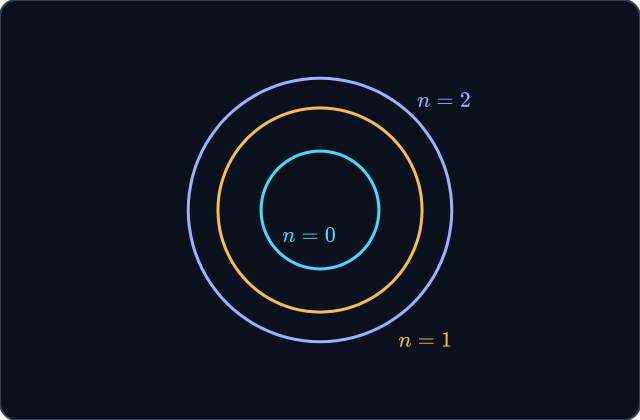
Classical orbits of the harmonic oscillator in the plane of and , in units of and , at the energies Bohr–Sommerfeld allows. Each encloses an area , and consecutive orbits differ by exactly : each quantum state takes one cell of that size.
Quantisation from WKB
For a potential well with two smooth turning points , WKB with the connection formulas gives the condition below. It is exact for the harmonic oscillator and asymptotically exact for large in general.
Properties
- is the area enclosed by the classical orbit in phase space.
- Each smooth turning point contributes ; a hard wall contributes . A box has , exact.
The quantisation condition
Carry the decaying solution across each turning point into the well. From the left one gets a cosine of the phase measured from , minus ; from the right, a cosine of the phase measured to , minus . Their phases add to the whole integral minus , and the two cosines are the same function up to a sign only if that is a whole multiple of .
Proof steps
From the turning point .
From the turning point , whose phase is .
The cosine is even.
Two cosines of the same variable agree up to sign only if their phases differ by a multiple of .
Rearrange.
Applications
Practice
One Cell per State
Each quantum state occupies an area of the classical phase space; the lowest occupies half of that.
Try it
For the oscillator, . What energy does Bohr–Sommerfeld give for , in units of ?
Where the Half Comes From
Each smooth turning point contributes of phase; the two together add , which is the half in .
Try it
Where does the in come from?
Exact for the Oscillator
For the harmonic oscillator the Bohr–Sommerfeld condition gives the exact levels, ; for other potentials it is best for large .
Try it
Bohr–Sommerfeld quantisation gives the exact energy levels of the harmonic oscillator.
Counting States by Area
The number of states below an energy is roughly the phase-space area of the orbit at that energy divided by .
Try it
A classical orbit at energy encloses a phase-space area of . About how many states lie below ?
Try it
For with , Bohr–Sommerfeld gives . What is it? Give three decimal places.
Try it
What condition does WKB give for a box with hard walls?
Try it
The old quantum theory, with , predicted the correct zero-point energy of the oscillator.
Final checkpoint
Try it
In units of , what phase-space area does the state of a well with two smooth turning points occupy, ? Give three decimal places.
Try it
For which levels is Bohr–Sommerfeld most accurate in a general well?
Try it
In units of and , the oscillator’s orbit at level is a circle of radius . What is its area for , in units of ? Give three decimal places.
Completion
Lesson complete
Great work! You now know how to:
- derive the quantisation condition from two connection formulas
- read it as one phase-space cell per state
- apply it to the oscillator, a box and a linear well