Intuition
Most Hamiltonians cannot be solved exactly, but their ground-state energy can still be pinned down from above. Take any state at all and compute the average energy in it: the answer is never below the true ground energy. So guess a family of states with a few adjustable numbers, compute the average energy as a function of them, and lower it as far as it will go. The best guess is an upper bound, and usually a good one: an error in the state makes only a second-order error in the energy.
Drop a ball anywhere into a valley and it comes to rest at a height at least as great as the lowest point. Searching over where to drop it, you learn the depth of the valley from above.
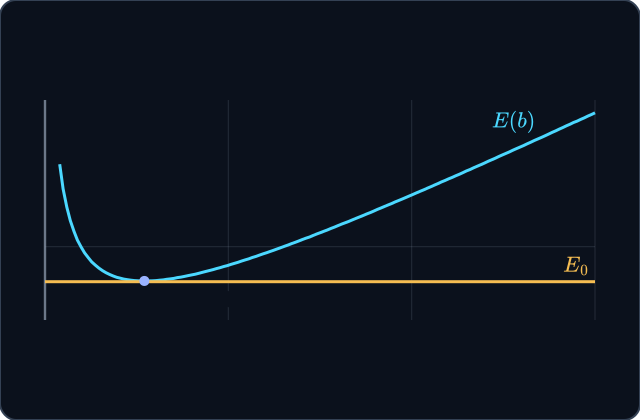
The average energy of the trial state for , against the width parameter . Every value lies above the true ground energy ; the best, at , is only half a per cent above it.
An upper bound on the ground energy
For any state in the domain of , the average energy is at least the ground energy. Equality holds only for the ground state.
Properties
- Minimising over a family of trial states gives the best upper bound the family allows.
- If the trial state differs from the ground state by , the energy differs by order : energies come out much better than the states.
- A trial state orthogonal to the ground state bounds the first excited energy from above, and so on up the ladder.
- The bound holds for any Hamiltonian bounded below, in any number of dimensions and for any number of particles.
- It gives no lower bound: a variational estimate can be too high, never too low.
The variational principle
Expand the trial state in the eigenstates of the Hamiltonian. Its average energy is a weighted average of the eigenvalues, with weights . No eigenvalue is below , so neither is any weighted average of them.
Proof steps
The eigenstates of form a basis.
Each eigenstate contributes its energy, weighted by its probability.
Every is at least .
Since .
Equality leaves no weight on higher levels: the trial state is a ground state.
Applications
Practice
Never Below
The average energy in any state is at least the ground-state energy. A variational estimate can be too high, never too low.
Try it
A trial state gives eV. What can be said of the true ground energy ?
A Weighted Average
Expanded in energy eigenstates, the average energy is the eigenvalues weighted by their probabilities, so it cannot fall below the lowest eigenvalue.
Try it
A trial state has probability 0.9 on the ground state, energy 1, and 0.1 on a state of energy 3. What is its average energy?
Better Energies Than States
If the trial state is wrong by a small amount , its energy is wrong only by an amount of order . A mediocre state can give a good energy.
Try it
A trial state 10 per cent wrong typically gives an energy about 10 per cent wrong.
Minimising Over a Parameter
With a trial family depending on a parameter, the average energy is a function of it. Its minimum is the best bound the family gives.
Try it
For with , the trial state gives . What is its least value? Give three decimal places.
Try it
How can the variational principle bound the first excited energy?
Try it
with and . What is ? Give three decimal places.
Try it
For the harmonic oscillator, the Gaussian trial family contains the exact ground state, so the variational bound is exact.
Final checkpoint
Try it
For , the trial state gives . What is ? Give three decimal places.
Try it
Why is every trial energy an upper bound on the ground energy?
Try it
The variational principle can also give a lower bound on the ground energy.
Completion
Lesson complete
Great work! You now know how to:
- prove the variational principle by expanding in eigenstates
- minimise a trial energy over a parameter
- explain why energies are more accurate than the states