Intuition
A good trial state is mostly good judgement: give it the symmetry the true state must have, make it obey the right conditions at walls and at infinity, and leave a few numbers free. For a box, a simple parabola that vanishes at both walls gives the ground energy to about one per cent. For more accuracy, take the trial state to be a combination of several fixed functions with free coefficients: minimising then becomes a matrix eigenvalue problem, the Rayleigh–Ritz method, and its lowest eigenvalue is the best bound the functions allow.
A tailor measures a few numbers — chest, waist, length — and cuts a suit that fits almost perfectly. A trial state with a few well-chosen parameters fits the ground state the same way.
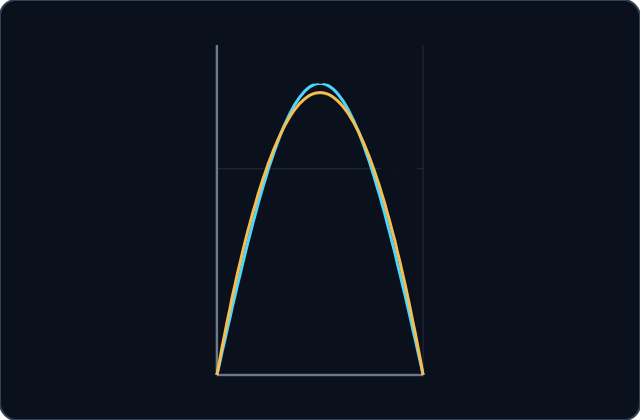
The ground state of a box of width 1 and the trial state , both normalised. They are hard to tell apart, and the trial energy, in units of , is only per cent above the exact .
Choosing trial states
A trial family should respect what is known about the ground state. A linear family turns the minimisation into an eigenvalue problem for the matrix of in the functions .
Guidelines
- Match the symmetry: an even potential has an even ground state, with no nodes.
- Match the boundary conditions: vanish at infinite walls, decay at infinity.
- Each eigenvalue of the Rayleigh–Ritz matrix bounds the corresponding true level from above, and adding functions can only lower them.
- With an orthonormal set the matrix equation is an ordinary eigenvalue problem; otherwise the overlaps enter.
The Rayleigh–Ritz method
Write the average energy as a ratio of two quadratic forms in the coefficients. At its minimum the derivative with respect to each coefficient vanishes, and that condition is the eigenvalue equation of the matrix . The lowest eigenvalue is the minimum, and so an upper bound.
Proof steps
The average energy in the trial state, with orthonormal .
At a stationary point, changing any coefficient does not change to first order.
The derivative gives the matrix eigenvalue equation.
The smallest eigenvalue is the minimum of the ratio, and a variational upper bound.
Applications
Practice
A Parabola in a Box
The trial state vanishes at both walls of a box of width 1, like the ground state. Its average energy is 10 in units of , against the exact .
Try it
The trial state in a box of width 1 gives energy 10 in units of ; the exact value is . By what percentage is the trial energy too high? Give one decimal place.
Respect the Symmetry
In an even potential the ground state is even and has no node. A trial state should be even too; an odd one bounds an excited level instead.
Try it
Which trial state suits the ground state of ?
More Functions Never Hurt
Adding a function to a Rayleigh–Ritz basis enlarges the family of trial states, so the minimum can only go down or stay the same.
Try it
Adding a function to a Rayleigh–Ritz basis can raise the lowest eigenvalue.
A Matrix Problem
With a trial state made of orthonormal functions with free coefficients, minimising the energy means finding the lowest eigenvalue of the matrix of in those functions.
Try it
In two orthonormal functions the Hamiltonian has matrix . What bound does Rayleigh–Ritz give on the ground energy?
Try it
Which trial state is suitable for the ground state of a box from to ?
Try it
Using only the first of two orthonormal functions, with , what bound does the variational principle give?
Try it
In an even potential, an odd trial state gives an upper bound on the first excited energy.
Final checkpoint
Try it
With in two orthonormal functions, what is the Rayleigh–Ritz bound on the ground energy?
Try it
Which property matters most in a trial family for the ground state?
Try it
Each eigenvalue of the Rayleigh–Ritz matrix, in order, is an upper bound on the corresponding true energy level.
Completion
Lesson complete
Great work! You now know how to:
- choose trial states with the right symmetry and boundary conditions
- turn a linear trial family into a matrix eigenvalue problem
- judge a trial state by the energy it gives