Intuition
Start a system in a level of the solved Hamiltonian, switch on a perturbation, and ask for the chance of finding it in another level later. To first order the amplitude is a single time integral: the perturbation’s matrix element between the two levels, weighted by a phase that turns at their Bohr frequency. A perturbation that changes slowly compared with that frequency averages to almost nothing; one with a component at the Bohr frequency adds up. The transition probability is the squared modulus of the amplitude, and first order can be trusted while it stays small.
Pushing a child on a swing: pushes timed to the swing’s own period add up, and pushes at random largely cancel. The amplitude integral adds the pushes with the swing’s phase attached to each.
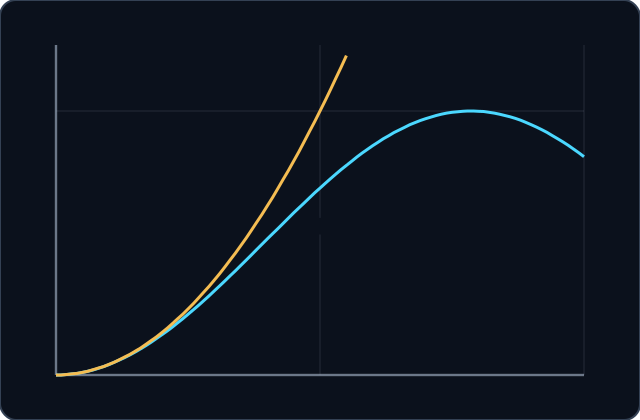
Two levels of equal energy coupled by a constant , the system starting in one: the probability of the other against . Exactly it is and never passes 1; first order gives , which agrees while both are small and then grows without bound.
The first-order transition amplitude
Expand the interaction-picture state in the eigenstates of , start it in , and keep the lowest order in the perturbation.
Properties
- The amplitudes obey exactly ; first order puts the starting values on the right.
The first-order amplitude
Write the interaction-picture state as a sum over the levels of and project its equation on the final level. The right-hand side involves every amplitude, but to lowest order they can be replaced by their starting values, which leaves a single known term to integrate.
Proof steps
Expand in the eigenstates of ; the system starts in .
Project the equation of the interaction picture on .
To lowest order, put on the right.
Integrate from , where for .
Applications
Practice
The Amplitude Integral
To first order, the amplitude of a jump from level to level is the time integral of the perturbation’s matrix element between them, with a phase turning at their Bohr frequency. For two levels of equal energy the phase stays at 1.
Try it
A constant eV couples two levels of equal energy. What is the first-order probability of the jump after a time with eV?
While It Stays Small
First order replaces the amplitude of the initial level by 1 on the right-hand side. That is only right while the initial level has hardly emptied, so the results hold while every transition probability is small.
Try it
First-order transition amplitudes can still be trusted after the transition probability has grown close to 1.
No Matrix Element, No First-Order Jump
A first-order amplitude is an integral of the one matrix element . If that element is zero at all times, nothing happens at first order, whatever the strength of the perturbation. A jump may still go in two steps, through a third level, at second order.
Try it
A perturbation has at every time. What can be said about the jump from to ?
A Fourier Component
For a perturbation that acts for a limited time, the amplitude integral is the Fourier transform of evaluated at the Bohr frequency. The pulse causes a jump only if it contains that frequency.
Try it
A brief pulse perturbs a system. What property of the pulse sets the first-order amplitude for the jump ?
Try it
A perturbation gives a first-order probability . It is made three times stronger, with the same time profile. What is at first order now?
Try it
At first order, the probability of equals the probability of under the same perturbation.
Try it
A perturbation is switched on and off very slowly compared with the period . What is its first-order transition probability like?
Final checkpoint
Try it
At first order, a system leaks from its initial level into three others, with probabilities 0.01, 0.02 and 0.005. What is the probability of still finding it in the initial level?
Try it
For two levels of equal energy coupled by a constant , the first-order probability stays below the exact probability .
Try it
In , what does first-order perturbation theory put for on the right?
Completion
Lesson complete
Great work! You now know how to:
- derive the first-order transition amplitude
- compute transition probabilities and say when they can be trusted
- read an amplitude as a Fourier component at the Bohr frequency