Intuition
Often the final levels are not one but a continuum — an electron knocked out of an atom can leave with any energy, a photon can go off in any direction. Then the resonance peak of the last lesson sweeps over many final levels at once. Its height grows as the square of the time and its width shrinks as one over the time, so the area under it, the probability summed over the levels, grows in proportion to the time: a constant rate. That rate is Fermi’s golden rule. A constant rate of leaving empties a level exponentially, and a level that empties in a time has an energy blurred by .
Water leaks from a tank through a sieve with thousands of holes of every size. Each hole alone would dribble unsteadily, but together they drain it at a steady rate — and a steady fraction lost each second empties the tank exponentially.
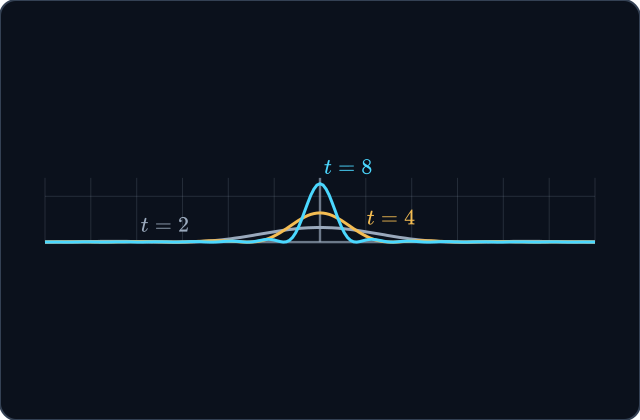
The resonance curve of a constant perturbation against the Bohr frequency, divided by so that the area under it is 1, after the times 2, 4 and 8. It grows in proportion to and narrows as : in the limit it is the delta function , which picks out the final levels of the initial energy.
Fermi’s golden rule
Let the final levels form a continuum with levels per unit energy. A constant perturbation empties the initial level into them at the constant rate:
Properties
- A periodic perturbation gives the same rate with in place of and for absorption, for stimulated emission.
The golden rule
Add up the constant-perturbation probability over a continuum of final energies. For long times the resonance curve is a narrow peak of area at the initial energy, so the sum picks out the final levels there and grows in proportion to the time.
Proof steps
The constant-perturbation result of the last lesson.
A continuum of final levels, of them per unit energy.
The peak narrows as while its area stays .
and change little across the narrow peak, so they leave the integral at .
A probability that grows in proportion to the time is a constant rate.
Applications
Practice
The Golden Rule
A transition into a continuum goes at a constant rate: times the squared matrix element, times the number of final levels per unit energy at the energy the jump conserves.
Try it
Which quantities set the rate of a transition into a continuum?
Two Factors
The rate is linear in the density of final levels and quadratic in the matrix element, so the two enter differently.
Try it
The density of final levels doubles and the matrix element halves. What happens to the golden-rule rate?
Linear in Time
Summed over a continuum, the probability of having left grows in proportion to the time, not as its square: the peak that grows as also narrows as .
Try it
Summed over a continuum of final levels, the first-order probability of having left the initial level grows in proportion to the time.
Exponential Decay
A constant rate of leaving empties a level exponentially. Its lifetime is the time in which the survival probability falls by a factor , one over the rate.
Try it
A level decays at the rate s. What is its lifetime, in ns?
Try it
What fraction of an ensemble of decaying systems is still undecayed after two lifetimes? Give three decimal places.
Try it
The 2p level of hydrogen lives ns. With eV s, what is its energy width ?
Try it
A level that decays can still have a perfectly sharp energy.
Final checkpoint
Try it
For a constant perturbation, which final levels does the golden rule count?
Try it
eV, levels per eV and eV s. What is , in units of s? Give two decimal places.
Try it
The golden-rule rate is proportional to the first power of .
Completion
Lesson complete
Great work! You now know how to:
- derive Fermi’s golden rule from the constant-perturbation result
- compute decay rates, lifetimes and widths
- say why decay into a continuum is exponential