Intuition
If the Hamiltonian changes abruptly — in a time short against over the energies involved — the state has no time to respond. Just after the change it is the same vector as just before, but it is no longer an eigenstate: spread over the eigenstates of the new Hamiltonian, it is found in each with the squared overlap. When tritium’s nucleus emits a fast electron and becomes helium-3, the atomic electron, still in hydrogen’s ground state, suddenly finds a doubly charged nucleus, and ends in the ion’s ground state only seven times in ten.
Pull a tablecloth out fast enough and the dishes stay where they were; pull it slowly and they slide along with it. The sudden approximation is the fast pull; the next lesson is the slow one.
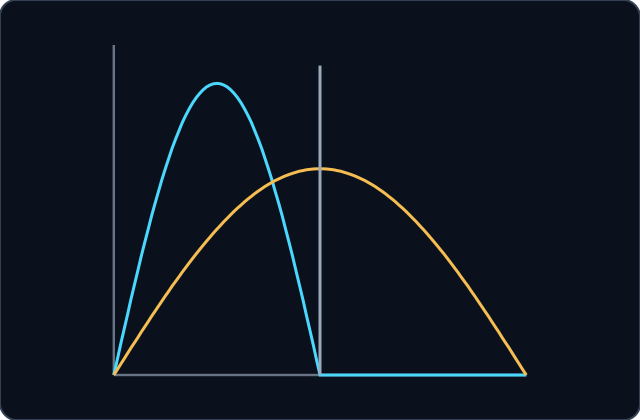
A particle in the ground state of a box of width 1, when the right wall is moved at once to 2. Just after, the wavefunction is unchanged (before); its overlap with the new ground state is , so the particle is found there with probability .
The sudden approximation
Let the Hamiltonian jump from to in a time much shorter than over the energies involved. The state is unchanged by the jump, and is then expanded in the eigenstates of .
Properties
- It holds when , with the spread of energies the state has under the Hamiltonians involved.
- The probability of leaving the initial state during the change itself is , derived below; it vanishes for an instant change.
Leaving the initial state during a quick change
During a short switch the evolution operator is the identity minus a term proportional to and to , the Hamiltonian averaged over the switch. The part of the evolved state outside comes from that term alone, and its squared length is times the variance of . As it vanishes: the state is left as it was.
Proof steps
To first order in the short time .
The part of the evolved state outside .
The identity term lies along and is removed.
is a projector, and is the variance of .
Applications
Practice
Too Fast to Follow
A Hamiltonian that changes in a time short against over the energies involved leaves the state as it was. Only afterwards does the state evolve, under the new Hamiltonian.
Try it
Just after a sudden change of the Hamiltonian from to , what is the state?
Tritium Becomes Helium
The ground states of one-electron ions of charges and overlap by a simple formula, found by integrating two exponentials.
Try it
In the decay of tritium the nuclear charge jumps from 1 to 2. What is the probability that the electron ends in the ground state of the helium ion? Give three decimal places.
The Energy Just After
Just after a sudden change the state is a mixture of the new levels, so its energy is their average weighted by the probabilities — in general not the energy of any one of them.
Try it
Just after a sudden change, must equal one of the eigenvalues of .
How Fast Is Sudden
Sudden means fast against the natural time of the state, divided by the spread of energies involved. There is no absolute standard of fast.
Try it
When can a change of the Hamiltonian lasting be treated as sudden?
Try it
A particle in the ground state of a box has the wall moved suddenly from to . Its overlap with the new ground state is . What is the probability of finding it in the new ground state? Give two decimal places.
Try it
In the same box, what is the energy just after the wall moves, in units of the new ground energy ?
Try it
After the wall of a box jumps from to , the particle is most likely to be found in the new ground state.
Final checkpoint
Try it
A nucleus suddenly changes its charge. Why can the atom’s electron end up excited?
Try it
A quick change is made twice as fast. What happens to the probability of leaving the initial state during the change?
Try it
For a change that is instantaneous, the probability of leaving the initial state during the change itself is zero.
Completion
Lesson complete
Great work! You now know how to:
- apply the sudden approximation and compute the probabilities of the new levels
- derive how much a quick change disturbs the state
- work the examples of tritium’s decay and of a box that suddenly doubles