Intuition
The opposite extreme: change the Hamiltonian slowly. Then a system that starts in the -th eigenstate stays in the -th eigenstate of the Hamiltonian of each moment, following it continuously, as long as the level never meets another. A box whose wall is moved out slowly keeps its particle in the ground state, whose energy falls smoothly; an oscillator whose spring slowly stiffens keeps its quantum number, its energy growing with the frequency. The only record of the journey is a phase.
Carry a full cup of coffee across a room slowly and it arrives full: the surface tilts gently and follows your hand. Rush, and the coffee sloshes into other motions. The adiabatic theorem is the slow walk.
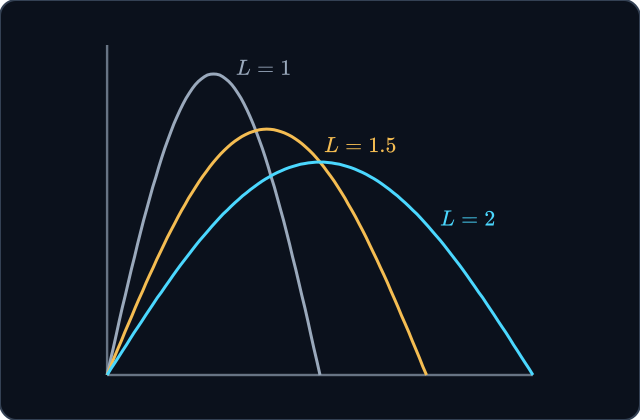
The same wall moved slowly from 1 to 2: the particle stays in the ground state of the box as it is at each moment, and the wavefunction widens with the box. Its energy falls as , to a quarter — while the sudden move of the last lesson left it in the new ground state only 36 times in 100.
The adiabatic theorem
Let change slowly, with the instantaneous eigenstates . A system starting in is later in , up to a phase:
Properties
- Slow means for every other level : the change must be gentle against the gaps, and a gap must never close.
Why a slow change keeps the level
Expand the state in the instantaneous eigenstates with their dynamical phases taken out. Schrödinger’s equation then changes each coefficient through the overlap of a state with its own rate of change, and through couplings to the other levels, each divided by a gap and turning at the difference of the dynamical phases. For a slow change the couplings are small and average away, and each coefficient keeps its size.
Proof steps
Expand in the instantaneous eigenstates, with the dynamical phases taken out.
Put it into : the terms with cancel against the derivative of .
Project on .
Differentiate in time and project on .
For a slow change the couplings are small and turn quickly, and are dropped; is imaginary, so only a phase is left.
Applications
Practice
Following the Level
Under a slow change a system that starts in the -th eigenstate stays in the -th eigenstate of the Hamiltonian of each moment. It keeps its place in the ladder of levels, not its energy.
Try it
A system starts in the second eigenstate of , and changes slowly with no level ever meeting another. Where is it at the end?
A Slowly Widened Box
When the wall of a box moves slowly, the particle stays in the level it started in, and that level’s energy follows the width of the box as one over its square.
Try it
The wall of a box moves slowly from to with the particle in the ground state. By what factor does its energy fall?
The Gap Must Stay Open
The couplings that could carry the system to another level are divided by the gaps. The theorem needs every gap to the followed level to stay open, and the change to be slow against it.
Try it
The adiabatic theorem needs the level being followed to stay apart from every other level it is coupled to.
An Adiabatic Invariant
An oscillator whose frequency changes slowly keeps its quantum number. Its energy over its frequency stays fixed.
Try it
An oscillator in its first excited state has its frequency raised slowly from to . By what factor does its energy grow?
Try it
The wall of a box in its ground state moves from to , once suddenly and once slowly. What is the probability of ending in the new ground state in each case?
Try it
During an adiabatic change that starts in one eigenstate, the probability spreads gradually over the other levels.
Try it
Which condition makes a change adiabatic for the level ?
Final checkpoint
Try it
An electron in a box of width 1 nm has ground energy eV. The wall moves slowly to 2 nm. What is its energy then, in eV?
Try it
The dynamical phase is the whole phase that an adiabatically carried state acquires.
Try it
Why do the electrons of a molecule stay in their ground state while its nuclei vibrate?
Completion
Lesson complete
Great work! You now know how to:
- state the adiabatic theorem and the condition it needs
- derive why a slow change keeps each level
- compare a slow change with a sudden one for a box and an oscillator