Intuition
Two perturbations can be integrated at once. A constant one switched on at a moment: the amplitude of a level at another energy oscillates and never grows large, while a level at the same energy fills steadily, its probability growing as the square of the time. A periodic one, oscillating at : now the level fills steadily when its Bohr frequency matches , above the initial level by , which is absorption, or below it by , which is stimulated emission. The longer the perturbation acts, the more sharply it picks out that frequency.
A radio tuned to one station hears only signals at its frequency; the others come and go without building up. Listen for longer and the tuning is sharper, until only the exact frequency gets through.
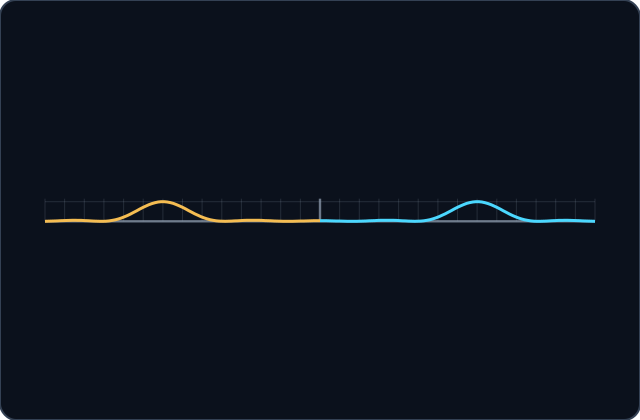
The first-order probability of a jump under a perturbation oscillating at , after a fixed time, drawn against the Bohr frequency of the final level and scaled to a peak of 1. It peaks at , a level higher (absorption), and at , a level lower (stimulated emission).
Constant and periodic perturbations
For constant from , and near resonance for , the amplitude integral gives:
Properties
- A constant perturbation and a level at another energy: the probability oscillates between 0 and . Measured against the phase of the initial level, the amplitude averages over time to , the admixture of the last chapter.
The constant perturbation
A constant matrix element leaves the amplitude integral, which is then the integral of a turning phase. Taking out half of the phase turns the difference of two exponentials into a sine, and squaring the modulus leaves the result.
Proof steps
is constant, so it leaves the integral.
Integrate the exponential.
Take out half the phase.
Square the modulus; the phase factors have modulus one.
Applications
Practice
A Constant Perturbation
For a level at another energy, the probability of a constant perturbation oscillates in time and never exceeds four times the squared ratio of the matrix element to the energy gap.
Try it
A constant perturbation with eV couples to a level eV above it. What is the largest first-order probability reached?
At Equal Energies
When the final level has the same energy, the phase in the amplitude integral never turns and the amplitude grows in proportion to the time. The probability then grows as the square of the time, for as long as it stays small.
Try it
A constant perturbation couples two levels of equal energy. How does the first-order probability grow at early times?
Up and Down Alike
A periodic perturbation has a part that raises the energy by and a part, its adjoint, that lowers it. Between one pair of levels their matrix elements have the same size, so upward and downward jumps are equally likely.
Try it
Under the same periodic perturbation, the first-order probability of absorption from to equals that of stimulated emission from back to .
Absorption and Emission
A perturbation oscillating at drives jumps to levels above the initial level, which is absorption, and to levels below it, which is stimulated emission.
Try it
A system in a level at eV is driven at eV. Which levels does it reach resonantly?
Sharper With Time
The peak of the probability against the Bohr frequency has a width of about divided by the time the perturbation has acted: long perturbations select a frequency sharply, short ones hardly at all.
Try it
A periodic perturbation acts for 10 ns. Roughly how wide is its resonance in angular frequency, taking , in units of s? Give two decimal places.
Try it
A constant perturbation between two levels of different energies eventually moves all the probability into the other level.
Try it
Two levels of equal energy are coupled by a constant . For how long does hold?
Final checkpoint
Try it
A periodic perturbation acts twice as long. How does the resonance peak of the probability against the Bohr frequency change?
Try it
Far from resonance, the probability of a jump caused by a constant perturbation grows without bound as time goes on.
Try it
A system in a level at eV is driven at eV and jumps down by stimulated emission. What is the energy of the level it lands in, in eV?
Completion
Lesson complete
Great work! You now know how to:
- compute the transition probability of a constant perturbation
- find the resonances of a periodic one, for absorption and stimulated emission
- relate the width of a resonance to the time the perturbation acts