Intuition
When the Hamiltonian is a solved part plus a perturbation that changes in time, most of what the state does is already known: every level turns its phase at its own frequency. That motion carries no news. The interaction picture takes it away, by turning every state back at the rate the solved part alone would turn it. What is left changes only because of the perturbation, and changes slowly when the perturbation is weak. The solved part’s motion is handed to the operators instead, so the picture sits between Schrödinger’s, where the state does all the moving, and Heisenberg’s, where the operators do.
To see how a gust of wind disturbs the hands of a clock, watch the clock from a frame that turns with its hands at their normal rate. In that frame an undisturbed hand stands still, and every movement you see is the gust’s doing.
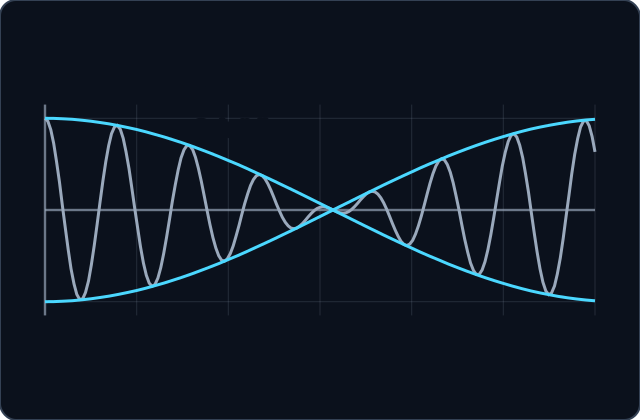
The real part of the amplitude of one level while a weak perturbation slowly empties it. In the Schrödinger picture it turns at the level’s own frequency inside a slow envelope; in the interaction picture that turning is removed, and what is left is the envelope, the slow change the perturbation causes.
The interaction picture
Split the Hamiltonian as , with solved. Undo in the state the evolution alone would cause, and give it to the operators.
Properties
- With the state stands still: everything does has been taken out.
The equation of the interaction picture
Differentiate the definition by the product rule. The derivative of the exponential brings down , which cancels the of Schrödinger’s equation, and what is left is the perturbation between the same two exponentials.
Proof steps
The definition.
The product rule: the exponential’s derivative brings down .
Schrödinger’s equation for the whole Hamiltonian.
commutes with its own exponential, so the two terms cancel.
Write .
Applications
Practice
Removing the Known Motion
The solved part of the Hamiltonian turns each level’s phase at its own frequency. The interaction picture undoes that turning in the state, so that the state changes only because of the perturbation.
Try it
What does passing to the interaction picture remove from the time dependence of the state?
Standing Still Without a Perturbation
The equation of the interaction picture has only the perturbation on its right-hand side. Switch the perturbation off and the state in this picture does not move at all.
Try it
With the perturbation switched off, a state in the interaction picture does not change in time.
Matrix Elements That Turn
Between two levels of the solved part, the perturbation in the interaction picture turns at the Bohr frequency of the pair: the difference of their energies divided by .
Try it
Two levels of have eV and eV. At what angular frequency does turn, in units of eV?
Between Two Pictures
In the Schrödinger picture states carry all the time dependence; in the Heisenberg picture operators do. The interaction picture splits it: operators move with the solved part, states with the perturbation.
Try it
How does the interaction picture share out the time dependence?
Try it
The probability of finding the system in an eigenstate of is different in the interaction picture from the Schrödinger picture.
Try it
A perturbation connects two levels eV apart. In the interaction picture its matrix element between them repeats with period . With eV fs, what is the period, in fs? Give two decimal places.
Try it
Why is the solution of a time-ordered product rather than the exponential of ?
Final checkpoint
Try it
The first correction to the identity in the Dyson series is of second order in the perturbation.
Try it
A system starts in . A constant perturbation with eV couples it to a level of the same energy. To first order, what is after a time with eV?
Try it
When is the interaction picture the right tool?
Completion
Lesson complete
Great work! You now know how to:
- pass to the interaction picture and derive its equation of motion
- read the matrix elements of the perturbation as turning at Bohr frequencies
- say why the solution is a time-ordered product