Intuition
In the position basis the position operator is as simple as an operator can be: it multiplies the wavefunction by . Its average in a state is the centre of mass of the probability density, and its spread is the width of that density. Any function of position, such as a potential energy, acts the same way — by multiplication.
The balance point of a beam with uneven weights is the weighted average of positions. The expectation value of position is the balance point of the probability density.
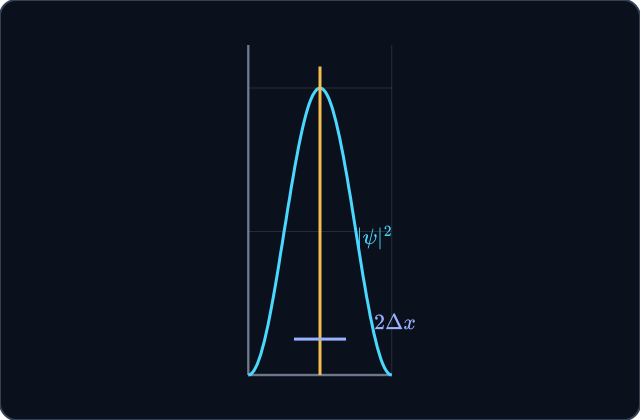
The density of a particle in a box of width 1. Its balance point is , the dashed line, and its spread is on each side, the green bar.
Position acts by multiplication
On wavefunctions the position operator multiplies by the coordinate: becomes . It is Hermitian because is real. Its expectation value and its moments are integrals of the density.
Moments of the density
- and .
The average position is an integral of the density
Insert the completeness relation of the position basis next to the operator. Each position state is an eigenvector of , so the operator turns into the number , and the remaining brackets are the wavefunction and its conjugate.
Proof steps
Insert between and the ket.
Each position state is an eigenvector of the position operator.
Pull the eigenvalue out as a number.
.
Applications
Practice
The Balance Point
The expectation value of position is the integral of times the probability density. A density symmetric about a point balances there.
Try it
on . What is ?
The Spread
The spread of position is .
Try it
For , with , what is ? Give three decimal places.
Multiplication
In the position basis the position operator multiplies the wavefunction by , and a function of position multiplies it by that function.
Try it
What is applied to the wavefunction ?
Real Multipliers Are Hermitian
Multiplying by a real function can be moved to either side of an integral bracket unchanged, so it is a Hermitian operator.
Try it
The position operator is Hermitian.
Try it
For on , . What is ? Give three decimal places.
Try it
A state is moved along the line: . What happens to and ?
Try it
For , what is the average of the potential , given ?
Final checkpoint
Try it
The eigenfunctions of the position operator are plane waves .
Try it
A density is symmetric about . What is ?
Try it
Which state has the larger : or ?
Completion
Lesson complete
Great work! You now know how to:
- act with the position operator by multiplication
- compute an average position and a spread from a density
- average any function of position against the density