Intuition
Multiply by and then differentiate, or differentiate and then multiply by : the two orders differ by exactly the function you started with. For position and momentum this is the canonical commutation relation, . From it comes Heisenberg’s uncertainty relation, and the proof that no finite matrices can describe a particle on a line.
Stretching a rubber band and then marking it is not the same as marking it and then stretching: the marks end up in different places by an amount set by the stretch. Position and momentum are two operations whose order leaves a fixed difference.
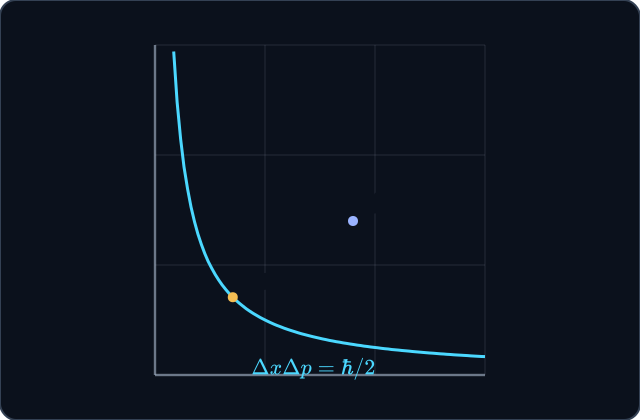
Spreads of position and momentum, in units where . Every state lies on or above the curve ; the region below it is forbidden. The Gaussian of the next lessons lies on the curve itself.
Position and momentum do not commute
Acting on any differentiable wavefunction, the two orders of position and momentum differ by times the wavefunction. Dirac read this as the quantum form of the classical bracket of position and momentum, and it is the central relation of quantum mechanics.
Consequences
- The uncertainty relation of the last chapter gives, in every state, .
The canonical commutation relation
Apply both products to a test function. Differentiating by the product rule produces one extra term, itself, which is all that survives the subtraction.
Proof steps
Differentiate first, then multiply by .
Multiply first, then differentiate with the product rule.
Subtract the second from the first.
The terms in cancel; this holds for every , so the commutator is .
Applications
Practice
Position and Momentum
Multiplying by after differentiating, minus differentiating after multiplying by , leaves times the function.
Try it
What is ?
The Product Rule Again
Commutators with products split into two terms. Applied to , each factor of contributes times the other.
Try it
What is ?
Heisenberg’s Relation
Put the canonical commutator into the uncertainty relation: the product of the two spreads is at least in every state.
Try it
An electron is confined to nm. What is the smallest it can have, in units of per nanometre?
No Finite Matrices
The trace of a commutator of two matrices is always zero; the trace of times the identity is not. So position and momentum can only be operators on an infinite-dimensional space.
Try it
There are matrices and with .
Try it
What is ?
Try it
Applied to , the operator gives . What is , in units of ?
Try it
.
Final checkpoint
Try it
In three dimensions, what is ?
Try it
Why is the bound the same in every state?
Try it
A normalisable state can have .
Completion
Lesson complete
Great work! You now know how to:
- prove the canonical commutation relation on a test function
- derive commutators of powers and functions of position and momentum
- turn the relation into Heisenberg’s uncertainty relation
- explain why finite matrices cannot describe a particle on a line