Intuition
A particle on a line can be found at any point, so its position has a continuum of possible values. The idealised state of being exactly at a point is written as a ket of its own, and the amplitude for a state to be found there, as runs over the whole line, is a function: the wavefunction. Every formula of the first chapter survives, with sums over a basis replaced by integrals over the line.
A list of numbers indexed by 1, 2, 3 is a vector; a function indexed by every point of a line is the same thing with a continuous index. The wavefunction is a state written out in the basis of positions.
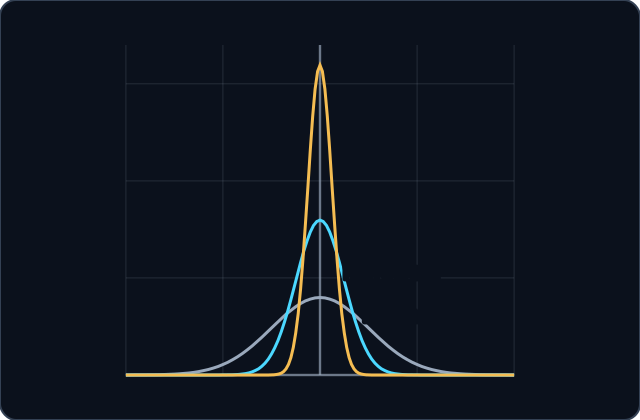
Three peaks of area 1, each half as wide and twice as tall as the one before. Their limit is the delta function : zero away from the origin and with total area 1, so that . It is the "wavefunction" of a particle exactly at a point.
The position basis
The position observable of a particle on a line has an eigenvalue for every real , with eigenstates . They are orthonormal in the continuous sense, with the Dirac delta in place of the Kronecker delta, and complete with an integral in place of a sum. The components of a state in this basis form its wavefunction.
From sums to integrals
- The delta function is defined by what it does inside an integral: for every continuous . It is the limit of ever narrower peaks of area one, not an ordinary function.
Brackets become integrals
Insert the completeness relation of the position basis between the bra and the ket. Each bracket with a position state is a value of a wavefunction, and the conjugate comes from reversing a bracket, exactly as in Parseval's identity with the sum replaced by an integral.
Proof steps
Put the completeness relation of the position basis in the middle.
The bra and the ket go inside the integral.
Brackets with position states are values of the wavefunctions, the first one reversed and so conjugated.
So the inner product of two states is the integral of one wavefunction's conjugate times the other.
Applications
Practice
The Delta Function Picks a Value
Integrated against any continuous function, the delta function centred at returns the value of the function at .
Try it
What is ?
Components in the Position Basis
The wavefunction at a point is the bracket of the position state at with the state. It is the amplitude for finding the particle at .
Try it
What is the wavefunction of a state ?
Different Points, Orthogonal States
Two position states at different points are orthogonal: a particle exactly at one point is certainly not at another.
Try it
For , the overlap is zero.
Inner Products Are Integrals
The bracket of two states is the integral over the line of the first wavefunction’s conjugate times the second.
Try it
What is ?
Try it
A wavefunction of a particle on a line is measured in which units?
Try it
A position eigenstate is a normalisable state that a particle can be prepared in exactly.
Try it
Two states on the line have wavefunctions for and zero elsewhere. What is ?
Final checkpoint
Try it
What replaces the sum in the completeness relation for the position basis?
Try it
What is ? Give three decimal places.
Try it
A state can be rebuilt from its wavefunction as .
Completion
Lesson complete
Great work! You now know how to:
- write a state in the position basis as its wavefunction
- use the delta function inside integrals
- turn brackets into integrals of wavefunctions