Intuition
De Broglie said a particle of momentum is a wave of wavelength . A wave has wavelength , so its momentum should be — and the operator that returns exactly that when it acts on the wave is times the derivative. Momentum measures how fast the phase of the wavefunction turns as you move along the line.
On a spiral staircase, how steep the climb feels depends on how tightly it winds. The momentum of a wavefunction is how tightly its phase winds along the line.
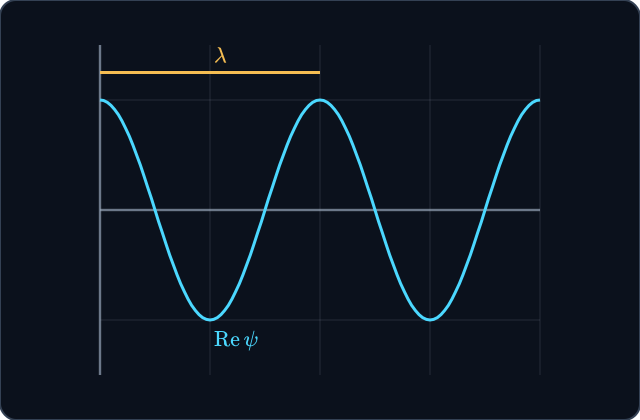
The real part of a plane wave , one wavelength marked. Its wavelength is , and by de Broglie its momentum is — exactly the eigenvalue of on it.
Momentum is a derivative
In the position representation the momentum operator is times the derivative. Plane waves are its eigenfunctions, with eigenvalues , which is de Broglie's relation read backwards. It is Hermitian on normalisable wavefunctions, by integration by parts.
What follows
- . A real wavefunction, or a real one times a constant phase, has .
The momentum operator is Hermitian
Integrate by parts to move the derivative from to . The boundary term vanishes because normalisable wavefunctions die away at infinity; the sign from integrating by parts and the sign from conjugating cancel, so the operator lands on the bra side unchanged.
Proof steps
Integration by parts.
Normalisable wavefunctions vanish at infinity.
Multiply by ; the minus signs combine.
Conjugating gives .
So acts the same way on either side: it is Hermitian.
Applications
Practice
Plane Waves Have Definite Momentum
The derivative of is times itself, so times the derivative returns times the wave.
Try it
What is ?
Real Wavefunctions Carry No Momentum
For a real normalisable wavefunction the average momentum is zero: the integrand is times a total derivative, whose integral vanishes, and the average must also be real.
Try it
A real, normalisable wavefunction has .
A Winding Phase Adds Momentum
Multiplying a wavefunction by makes its phase wind faster along the line, and adds to its average momentum.
Try it
is real and normalised. What is for , in units of ?
Standing Waves
A sine wave is the sum of two plane waves going opposite ways. It is an eigenfunction of but not of .
Try it
Which is true of ?
Try it
What is the eigenvalue of on , in units of ?
Try it
The momentum operator is Hermitian because the minus sign from integrating by parts cancels the minus sign from conjugating .
Try it
What is the kinetic energy operator in the position representation?
Final checkpoint
Try it
A plane wave has wavelength nm. What is its momentum, in units of per nanometre? Give three decimal places.
Try it
A momentum eigenstate is a normalisable state on the whole line.
Try it
How is computed from a wavefunction?
Completion
Lesson complete
Great work! You now know how to:
- act with the momentum operator as a derivative
- find momentum eigenfunctions and their eigenvalues
- prove that the momentum operator is Hermitian
- compute an average momentum from a wavefunction