Intuition
The modulus squared of the wavefunction is a probability density: integrate it over a stretch of the line and you get the probability of finding the particle there. Over the whole line the probability must be one, which fixes the size of the wavefunction; multiplying it by the right constant is called normalising. The probability of any single exact point is zero, just as a single point of a coastline has no length.
Rainfall per square metre is a density; how much fell on a field is the density integrated over the field. The wavefunction squared is rainfall of probability, and over the whole map exactly one unit falls.
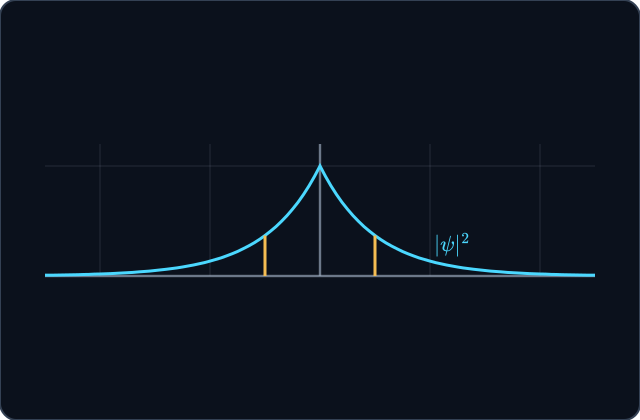
The density of the normalised state . The probability of finding the particle between the dashed lines, , is the area under the curve there: .
Probability density
By the Born rule, is the probability density for position: the probability of finding the particle between and is the integral of the density over that stretch. Normalisation says the particle is somewhere.
Working with densities
- To normalise , divide it by . A global phase is left free.
Normalising a decaying exponential
The density is symmetric, so its integral over the line is twice the integral over the positive half, which is an elementary exponential integral. Setting the result equal to one fixes the modulus of , and leaves its phase free.
Proof steps
Square the modulus of the wavefunction.
The density is even, so integrate over half the line and double.
.
Set the total probability to one.
Applications
Practice
Area Under the Density
The probability of finding the particle in a stretch of the line is the area under the probability density over that stretch.
Try it
A particle has the normalised wavefunction on and zero elsewhere. What is the probability of finding it in ?
Normalising
To normalise a wavefunction, compute the integral of its modulus squared over the whole line and divide the wavefunction by the square root of that number.
Try it
For which positive is normalised? Give three decimal places.
No Probability at a Point
A probability density gives probability to stretches of the line. A single point has zero width, so the chance of an exact value is zero.
Try it
For a particle with a continuous wavefunction, the probability of finding it at exactly is .
Exponential Densities
For the density , the probability within a distance of the origin is .
Try it
For the normalised wavefunction , what is the probability of finding the particle with ? Give three decimal places.
Try it
A probability density can take values greater than one.
Try it
With on , what is the probability of finding the particle in ? Give three decimal places.
Try it
For which positive is normalised?
Final checkpoint
Try it
on and zero elsewhere. For which positive is it normalised, given ? Give two decimal places.
Try it
A wavefunction satisfies . What is the probability of finding the particle at ?
Try it
If is normalised, so is for any real .
Completion
Lesson complete
Great work! You now know how to:
- read the modulus squared of a wavefunction as a probability density
- compute the probability of a stretch of the line
- normalise a wavefunction