Intuition
A state can be written in the momentum basis just as well as in the position basis. Its components there form the momentum-space wavefunction, whose modulus squared is the probability density for momentum. The two descriptions are related by the Fourier transform, and the transform has a built-in trade-off: a wavefunction squeezed narrow in position is necessarily spread wide in momentum.
A chord can be described by the air pressure against time or by the list of notes in it. The two are the same sound, turned into each other by a Fourier transform; a short click contains every note at once.
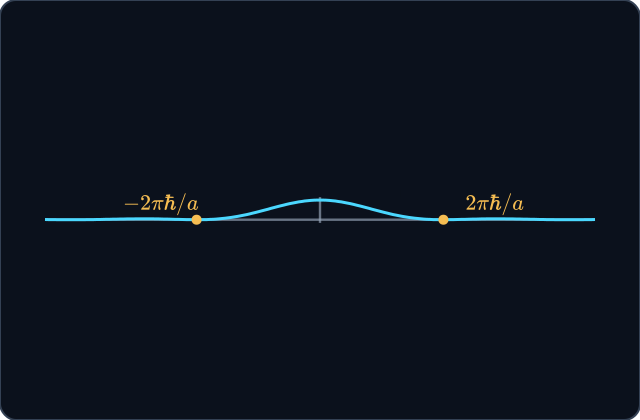
The momentum density of a particle spread evenly over a box of width , in units where . It vanishes first at : squeezing the box, making smaller, pushes those zeros out and spreads the momentum.
The Fourier transform between x and p
The momentum-space wavefunction is the component of the state along each momentum eigenstate. Since , it is the Fourier transform of the position wavefunction, and the position wavefunction is the inverse transform of it.
Properties
- The inverse transform: .
Momentum eigenfunctions are plane waves
Write the eigenvalue equation of momentum in the position representation: it is a first-order differential equation whose solutions are exponentials. The constant in front is fixed by asking the momentum states to be normalised to a delta function, using the Fourier integral .
Proof steps
The eigenvalue equation in the position basis.
A first-order linear equation with constant coefficients; the Differential Equations course solved these by an exponential.
Insert the position completeness relation and use the Fourier integral of the delta function.
Demand , choosing real.
Applications
Practice
Components Along Momentum States
The momentum-space wavefunction is the bracket of each momentum eigenstate with the state: the amplitude for each momentum. It is the Fourier transform of the position wavefunction.
Try it
What is ?
Plancherel
The Fourier transform keeps the total: the integral of the modulus squared is the same in position and in momentum. A normalised state is normalised in both descriptions.
Try it
If is normalised, then is normalised too.
Narrow Here, Wide There
The narrower a wavefunction is in position, the wider its transform is in momentum. That is the Fourier transform’s own uncertainty relation.
Try it
A wavefunction is squeezed to half its width in position. What happens to its momentum density?
A Box and Its Transform
A wavefunction spread evenly over a box of width has a momentum density shaped like the square of , which first vanishes at .
Try it
A particle is spread evenly over a box of width nm. At what momentum, in units of per nm, does its momentum density first vanish? Give three decimal places.
Try it
How does the position operator act on a momentum-space wavefunction?
Try it
is centred at . Where is the momentum density of centred, with momentum in the same units?
Try it
For a real wavefunction , the momentum density satisfies .
Final checkpoint
Try it
is moved along the line to . What happens to its momentum density ?
Try it
A wavefunction has . What is ?
Try it
In momentum space, acts on by multiplying it by .
Completion
Lesson complete
Great work! You now know how to:
- write a state in momentum space as a Fourier transform
- derive the momentum eigenfunctions and their normalisation
- use Plancherel and the narrow-wide trade-off
- act with position and momentum in momentum space