Intuition
Put an atom in a magnetic field and each spectral line splits into several — Zeeman saw it in 1896. The field adds to the Hamiltonian, and how it splits the levels depends on its strength against the spin–orbit coupling. In a weak field the spin–orbit coupling wins, the good states are those of definite and , and each level splits into equally spaced sublevels, from the centre. The Landé factor records how much of is spin: it is 1 when is all orbit and 2 when it is all spin. Because the spin’s is 2 and not 1, the pattern depends on and : this was the anomalous Zeeman effect before spin was known. In a strong field the field wins, the good states are those of definite and , and the shifts are : the Paschen–Back effect.
Two dancers holding hands spin as a pair, and a gentle push acts on the pair as a whole; a hard shove separates them, and each answers for itself. A weak field acts on the coupled , a strong one on and apart.
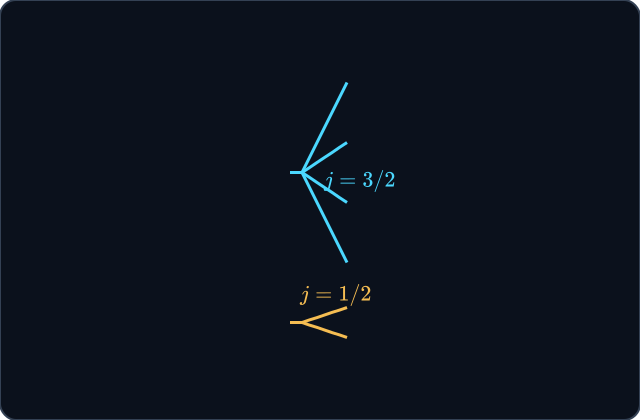
Hydrogen’s levels in a weak field, to first order: above splits into four sublevels with , and below into two with . Energies are in units of the spin–orbit gap between the two levels, the field as in the same units; the straight lines hold while the shifts stay small beside the gap.
The Zeeman effect
An atom in a field along gains . In a weak field, small beside the spin–orbit splitting, a level splits as
Properties
- The sublevels are equally spaced, apart: the field removes the degeneracy in completely.
The Landé factor
. Within one level of given , the Wigner–Eckart theorem makes every vector operator proportional to , so there acts as a number times . Taking the dot product with finds from , which the squares of , and give.
Proof steps
.
Both are vector operators: by the Wigner–Eckart theorem their elements within one level differ only in the reduced element.
Insert between and ; does not take a state out of the level.
Square .
.
Applications
Practice
The Landé Factor
In a weak field a level splits into sublevels, from its centre, with set by , and .
Try it
What is for a level, , , ? Give three decimal places.
Sublevels
The field removes the degeneracy in completely: a level splits into sublevels.
Try it
Into how many sublevels does a level split in a weak field?
The Normal Effect
Without spin, , the Landé factor is 1 for every level, and every line splits into the same three.
Try it
For a level with , whatever is.
Why \mathbf{S} Follows \mathbf{J}
Within one level, the Wigner–Eckart theorem makes the spin act as a fixed multiple of .
Try it
Why is proportional to ?
Try it
Hydrogen’s level has . How far apart are its two sublevels at T, with eV/T, in units of eV? Give two decimal places.
Try it
In a strong field the good states are those of definite and .
Try it
In the Paschen–Back regime, what is the shift of the state , , in units of ?
Final checkpoint
Try it
Why was the Zeeman pattern of most atoms called anomalous?
Try it
Every level of hydrogen has .
Try it
When is a field weak in the sense of the Landé formula?
Completion
Lesson complete
Great work! You now know how to:
- derive the Landé factor from the Wigner–Eckart theorem
- find how a level splits in a weak field
- tell the weak-field pattern from the Paschen–Back one