Intuition
The potentials are not fixed by the fields. Add the gradient of any function to and subtract its time derivative from , and and are unchanged, because a gradient has no curl. In quantum mechanics the Hamiltonian contains itself, so the Schrödinger equation would change — unless the wavefunction changes too. Multiplying it by the phase , different at every point, exactly compensates. Densities, currents and energies stay the same; only the phase of the wavefunction and the canonical momentum depend on the choice. This is gauge invariance, and it can be read the other way round: demanding that a local change of phase be harmless forces the potentials into the Hamiltonian, in the combination .
Heights on a map can be measured from sea level or from the valley floor; slopes, which are all a walker feels, do not care. Potentials are like the heights and fields like the slopes, and the wavefunction’s phase has to be re-measured along with the potentials.
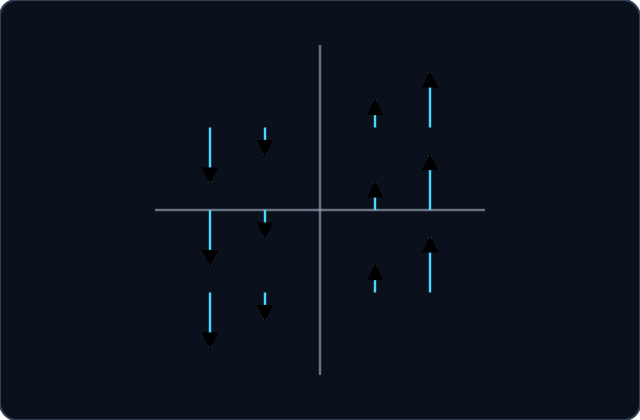
The Landau gauge of a uniform field along , drawn at half scale: it points along , up to the right of the axis and down to its left, growing with the distance from it. It differs from the circling by the gradient of , and has the same curl.
Gauge transformations
For any smooth function , the potentials and the wavefunction may be changed together:
Properties
- because , and because the changes of and of cancel.
Gauge invariance of the Schrödinger equation
The momentum acting on the phase brings down , which the change of removes, so the kinetic momentum passes through the phase unchanged, and so does its square. The time derivative acting on the phase brings down , which the change of removes.
Proof steps
The product rule with .
cancels against .
Apply the last line twice.
brings down from the phase, which cancels.
Combine the last two lines: one side vanishes exactly when the other does.
Applications
Practice
Changing the Potentials
Adding to and subtracting from changes neither nor .
Try it
is changed to . What must be done to to keep the same?
Changing the Phase
To keep the Schrödinger equation, the wavefunction is multiplied by a phase that varies from point to point.
Try it
How must the wavefunction change when ?
What Stays
Probability densities, currents and energies are the same in every gauge; only the phase of the wavefunction and the canonical momentum change.
Try it
A gauge transformation changes the probability density .
Two Gauges, One Field
The symmetric gauge and the Landau gauge give the same uniform field; they differ by the gradient of .
Try it
With T, what is the component of the Landau gauge minus the symmetric gauge at m, m, in T m?
Try it
What is for , with in tesla metres and in metres, in tesla?
Try it
The expectation value of the canonical momentum is the same in every gauge.
Try it
For an electron, per T m². By how much, in radians, does its phase change at a point where T m²? Give the size, to two decimal places.
Final checkpoint
Try it
Which of these is the same in every gauge?
Try it
For a gauge function that does not depend on time, the energy levels are the same in every gauge.
Try it
Why is the Landau gauge convenient for a uniform field?
Completion
Lesson complete
Great work! You now know how to:
- change the potentials without changing the fields
- change the wavefunction’s phase to match
- tell what depends on the gauge from what does not