Intuition
Split an electron beam round a long, thin solenoid and let the two halves meet on a screen. Outside the solenoid there is no magnetic field at all, so no force acts on the electrons. Yet switching the current on shifts the interference fringes. The vector potential outside is not zero: it circles the solenoid, and although it is the gradient of a function on each side, no single-valued function does for the whole way round. The two paths pick up phases that differ by times the flux inside. Aharonov and Bohm predicted it in 1959, and Tonomura’s electron holography confirmed it beyond doubt in 1986. In quantum mechanics the potentials act, through the phases they give round closed loops, even where the fields vanish.
Walk round a spiral staircase back to where you started: you are above the same spot, but a floor higher. Only a whole loop reveals it. Round the solenoid the electron’s phase climbs by in the same way, while every step looks like level ground.
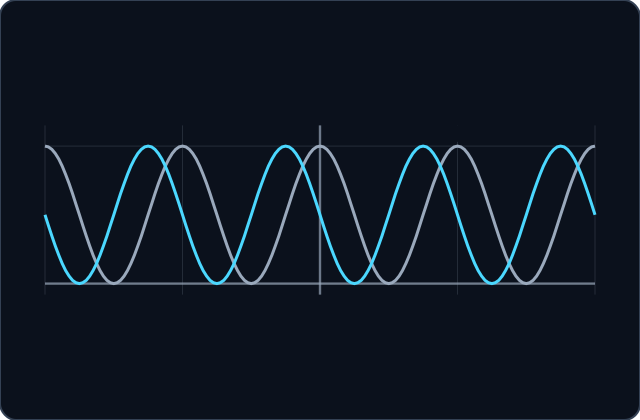
Electron fringes on a screen, the intensity against the position in fringe widths, from two paths passing either side of a long solenoid: dashed with no current, solid with a quarter of a flux quantum inside. The whole pattern shifts by a quarter of a fringe, though no field reaches the paths.
The Aharonov–Bohm effect
Two paths from a source to a point on the screen pass on opposite sides of a region enclosing the magnetic flux , with on both paths. The interference between them gains the phase
Properties
- The phase depends only on the flux enclosed, not on the shape of the paths or on how the field is spread inside.
- It is periodic: a flux of , for an electron Wb, gives and leaves the pattern as it was.
The Aharonov–Bohm phase
Where the field vanishes the potential is, along each path, a gradient, so each path’s wave is the field-free one times the phase along it — the gauge transformation of the last lesson. The two phases differ by the integral round the loop the two paths make together, which Stokes’s theorem turns into the flux inside.
Proof steps
Along path , with ; is the wave with no potential.
Out along path 1 and back along path 2 is one closed loop.
Stokes’s theorem; the curl is , nonzero only inside the solenoid.
is the field-free phase difference: the fringes shift by of a fringe.
Applications
Practice
No Field, Still an Effect
Outside a long solenoid , yet the vector potential circles it; electrons passing on either side interfere with a phase set by the flux inside.
Try it
In the Aharonov–Bohm experiment, the electrons are deflected by a magnetic force outside the solenoid.
The Phase
The two paths together make a loop round the flux, and their phases differ by times the flux enclosed.
Try it
What does the Aharonov–Bohm phase difference depend on?
The Flux Quantum
A flux of gives a phase of and changes nothing: the effect repeats with that period.
Try it
With J s and C, what is , in units of Wb? Give two decimal places.
Fringe Shift
The pattern moves by the fraction of a fringe.
Try it
A flux of Wb is enclosed. By what fraction of a fringe does an electron pattern shift? Give two decimal places.
Try it
Why is the Aharonov–Bohm phase not an artefact of the gauge?
Try it
Enclosing a flux of exactly leaves an electron interference pattern unchanged.
Try it
In a superconductor the charge carriers are pairs of electrons, . What is the flux period , in units of Wb? Give two decimal places.
Final checkpoint
Try it
Where is the vector potential nonzero in the Aharonov–Bohm arrangement?
Try it
Classical mechanics predicts the Aharonov–Bohm shift, since the vector potential bends the electrons’ paths.
Try it
The solenoid is moved so that one path passes much closer to it, still outside. What happens to the phase difference?
Completion
Lesson complete
Great work! You now know how to:
- derive the Aharonov–Bohm phase from the loop integral of
- find the flux quantum and the fringe shift
- explain why the effect is real and not a gauge artefact