Intuition
Bring a strong magnet near most materials and nothing seems to happen, but a sensitive balance shows a tiny push. Some substances are pushed away, the diamagnets, and some are pulled in, the paramagnets, and the difference lies in their atoms. The Hamiltonian of an atom in a field has two field terms. The linear one, the Zeeman energy of the atom’s moment, lowers the energy of a moment lined up with the field, so atoms with a moment are paramagnetic — although at room temperature heat keeps them almost random, and the magnetisation grows only as , which is Curie’s law. The quadratic one, for each electron, is positive: it raises the energy and pushes the atom out of the field. Atoms with closed shells have nothing else, so they are diamagnetic. Classical physics, oddly, allows neither: a theorem of Bohr and van Leeuwen shows that a classical system in thermal equilibrium has no magnetisation at all.
Compass needles in a shaken box point every which way; a field lines them up a little, the more the gentler the shaking. That is paramagnetism. Diamagnetism is different in kind: every orbit resists a change of the flux through it, like a coil pushing back on a magnet thrust into it.
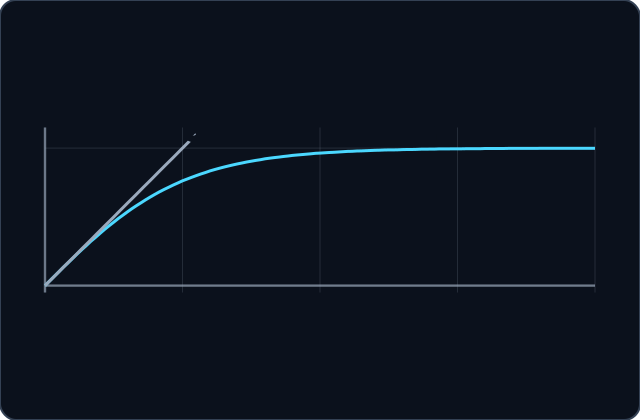
The average moment along the field of spin- atoms, in units of , against : starts along the straight line of Curie’s law and saturates at full alignment. At room temperature and 1 T the ratio on the axis is only .
Diamagnetism and paramagnetism
To second order in a weak field along , an atom’s energy is the Zeeman energy of its moment, the second-order Zeeman shift , and the diamagnetic term of every electron :
Properties
- The moment along the field is , and the susceptibility : negative for a diamagnet, which is pushed out of a field, positive for a paramagnet, which is pulled in.
Closed shells are diamagnetic
In a closed shell the moments cancel, so only the term quadratic in the field is left. For a field along it holds the squared distance of each electron from the axis, and in a spherically symmetric atom that averages to two thirds of the squared distance from the nucleus. The energy rises with the square of the field, so the moment it induces points against the field.
Proof steps
Minimal coupling with for each electron, with the spins’ moments added.
A closed shell has , so the linear term vanishes at first and at second order.
For along .
Spherical symmetry: .
The first-order shift from the quadratic term: the energy rises, and the induced moment opposes the field.
Applications
Practice
Pushed Out or Pulled In
A diamagnet’s energy rises in a field, so its induced moment opposes the field and it is pushed away; a paramagnet’s moment lines up and it is pulled in.
Try it
What is the sign of a diamagnet’s susceptibility?
Closed Shells
Atoms with closed shells have no moment; only the quadratic term acts, and it raises the energy.
Try it
Helium, with a closed shell, is paramagnetic.
Averaging Over Directions
In a spherically symmetric state the squared distance from the axis averages to two thirds of the squared distance from the centre.
Try it
An electron in a spherically symmetric state has . What is , in units of ?
Curie’s Law
Heat keeps moments random. For a spin the average moment along the field is , which grows as while that is small.
Try it
What is for a spin when ? Give three decimal places.
Try it
With eV/T and eV at room temperature, what is at T, in units of ? Give two decimal places.
Try it
How does a paramagnet’s susceptibility depend on the temperature, by Curie’s law?
Try it
A classical gas of charged particles in thermal equilibrium would be diamagnetic.
Final checkpoint
Try it
An atom has but . Where does its paramagnetism come from?
Try it
Every electron contributes a diamagnetic term, even in a paramagnetic atom.
Try it
What does of a spin approach in a very strong field at low temperature?
Completion
Lesson complete
Great work! You now know how to:
- show that closed shells are diamagnetic
- derive Curie’s law for a spin
- say where each kind of magnetism comes from