Intuition
A charge going round a loop is a small magnet. Expanding the minimal-coupling Hamiltonian in a uniform field shows it: the term linear in is with , the orbital magnetic moment. For an electron , so the moment points against the angular momentum, in units of the Bohr magneton . The spin has a magnetic moment too, twice as large for its angular momentum: where the orbit has 1. Pauli wrote the Hamiltonian of an electron with both, acting on two-component spinors. And there is a neat way to see where the 2 comes from: write the kinetic energy as , which is the same thing when there is no field, and in a field the spin term appears by itself, with exactly 2.
A charged ball spinning on its axis is a small magnet, and so is a charge running round a ring. Both turn angular momentum into a magnetic moment, but the electron’s spin does it twice as effectively as its orbit — a hint that spin is not a ball spinning.
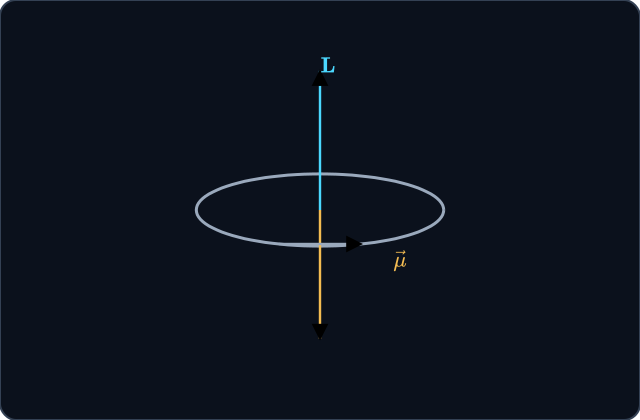
An electron on a circular orbit seen from the side, moving to the right along the near side. Its angular momentum points up by the right-hand rule; its charge is negative, so its magnetic moment points down.
Magnetic moments and the Pauli Hamiltonian
An electron, of charge , has orbital and spin magnetic moments, and in the potentials the Pauli Hamiltonian:
Properties
- A charge with angular momentum has the moment , read off the term of minimal coupling.
The spin term from the Pauli identity
The Pauli matrices multiply as , so a product of two dot products is a dot product plus times a cross product. Without a field the cross product of the momentum with itself vanishes; in a field the kinetic momenta do not commute, and it is proportional to , which leaves the spin term with .
Proof steps
From , for that commute with , kept in this order.
Put .
The commutator of the first lesson with ; the other components alike.
.
: the spin term with .
Applications
Practice
The Orbital Moment
For an electron the orbital magnetic moment points against the angular momentum: .
Try it
An electron is in a state with . What is , in units of ?
Against the Spin
The electron’s charge is negative, so its orbital and its spin moments each point against the corresponding angular momentum.
Try it
How is an electron’s spin magnetic moment directed relative to its spin?
Twice as Magnetic
For the same angular momentum the spin gives about twice the moment of an orbit: for the spin, 1 for the orbit.
Try it
Per unit of angular momentum, an electron’s spin is about twice as magnetic as its orbit.
Pauli’s Identity
The product of two dot products with the Pauli matrices is a dot product plus times a cross product.
Try it
What is with no field?
Try it
What energy separates the two spin states of a free electron in T, taking and eV/T, in units of eV? Give two decimal places.
Try it
The Pauli Hamiltonian acts on two-component wavefunctions.
Try it
An unpaired electron with is in a field of T. With GHz/T, at what frequency does it absorb, in GHz? Give one decimal place.
Final checkpoint
Try it
Why does differ from in a magnetic field?
Try it
The measured of the electron’s spin is exactly 2.
Try it
What is the energy of a magnetic moment in a field ?
Completion
Lesson complete
Great work! You now know how to:
- find the orbital magnetic moment from minimal coupling
- write the Pauli Hamiltonian with the spin’s moment
- derive from the Pauli identity