Intuition
A charge in electric and magnetic fields feels the Lorentz force, . Its magnetic part depends on the velocity and cannot be written as minus the gradient of a potential energy, so a Hamiltonian needs the potentials instead: the scalar potential and the vector potential , with and . Classical mechanics already has the answer, , and quantum mechanics keeps it with . This is minimal coupling: the momentum is shifted by the charge times the vector potential. It splits momentum in two. The canonical momentum , which generates translations, is no longer times the velocity; the kinetic momentum is, and its components do not commute.
A walker on a moving walkway can be timed by the pace of the legs or by the speed past the walls, and the two differ by the walkway’s speed. Canonical and kinetic momentum differ by in the same way, on a walkway whose speed changes from place to place.
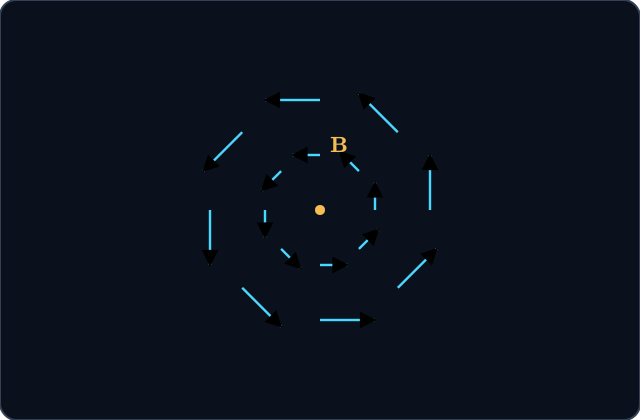
The vector potential of a uniform field pointing out of the page, drawn at points on two circles round the origin: it circles the field’s axis and grows in proportion to the distance from it. Its curl is everywhere.
Minimal coupling
A particle of charge and mass in the potentials and , with and , has the Hamiltonian
Properties
- The kinetic momentum is times the velocity, ; the canonical momentum still obeys and generates translations, but it is not .
Velocity in a magnetic field
Heisenberg’s equation gives the velocity as a commutator of the Hamiltonian with the position. Of the kinetic momenta only fails to commute with , and its square gives . For the second statement, the canonical momenta commute with one another and so do the components of , so only the cross terms survive; each is a derivative of , and together they make its curl.
Proof steps
Heisenberg’s equation; commutes with .
commutes with , and so do and .
Put the commutator into the first line.
and .
for any function of position.
Applications
Practice
The Hamiltonian
A charge enters the Hamiltonian through the potentials: the momentum is shifted by times the vector potential, and is added.
Try it
Which Hamiltonian describes a particle of charge in the potentials and ?
Two Momenta
The canonical momentum is no longer times the velocity. The kinetic momentum is.
Try it
In a magnetic field, the velocity of a charged particle is , with .
Moving Without Canonical Momentum
A particle can have zero canonical momentum and still move: its velocity is .
Try it
An electron, , is in a state with in a region where T m. With C/kg, what is , in m/s?
Velocities That Do Not Commute
In a magnetic field the components of the kinetic momentum fail to commute: their commutator is times the field.
Try it
What is for ?
Try it
A uniform field T along has . What is at the point , m, in T m?
Try it
The magnetic part of the Lorentz force depends on the velocity, so it cannot be written as minus the gradient of a potential energy.
Try it
For a uniform field and , which term linear in appears in the Hamiltonian?
Final checkpoint
Try it
For an electron the term is , with eV/T. What is it for and T, in units of eV? Give two decimal places.
Try it
With , the operators and are equal.
Try it
Which momentum still generates translations in a magnetic field?
Completion
Lesson complete
Great work! You now know how to:
- write the Hamiltonian of a charge in electromagnetic potentials
- tell the canonical momentum from the kinetic one
- show that the kinetic momenta do not commute in a magnetic field