Intuition
A power series is a series of functions whose terms are the simplest possible: constants times powers. Their behaviour is remarkably tidy. There is a number, possibly zero and possibly infinite, such that the series converges absolutely inside that distance of the centre and diverges outside it, and on any closed interval strictly inside it converges uniformly. The number comes straight out of the root test of chapter five.
A radio transmitter with a definite range. Inside the range the signal is received cleanly, outside it not at all, and exactly at the boundary the behaviour has to be tested transmitter by transmitter. The range is computed from the transmitter alone and not from where the receiver happens to stand.
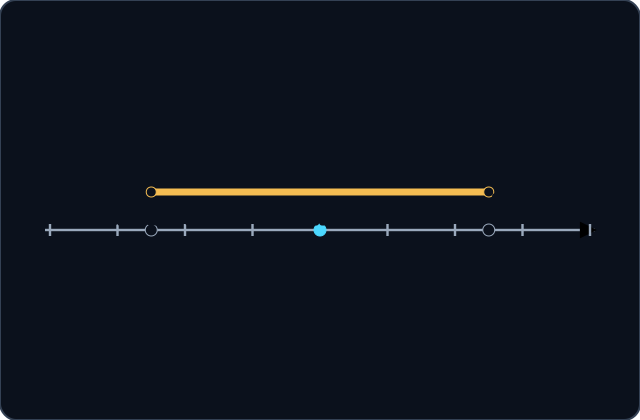
Inside the radius the series converges absolutely and outside it diverges. The two endpoints are hollow because nothing general can be said about them: a series may converge at both, at one, or at neither.
The radius, and what happens where
A power series about is . There is an , the radius of convergence, with the series converging absolutely for and diverging for . It converges uniformly on every closed interval with . The radius is , with the conventions that a zero denominator gives infinity and an infinite one gives zero.
Reading the radius
- At the two endpoints anything may happen: diverges at both, converges at one, at both.
Uniform convergence strictly inside the range
Apply the M-test with the obvious bounds. On the closed interval of radius chosen strictly inside the range, each term is bounded by the size of its coefficient times that radius to the power, and those numbers do not depend on the point. Their series converges, because the radius chosen lies inside the range where the series converges absolutely — and absolute convergence at a point of the range is exactly the convergence of that series of numbers. The M-test then delivers uniformity.
Proof steps
Bound each term by a number, with no dependence on the point.
The point at distance the chosen radius lies inside the range, where convergence is absolute.
These are the numbers the M-test asks for.
The M-test applies, and the conclusion is uniform on that closed interval.
Applications
Practice
One Number Decides Everything But Two Points
Inside the radius, absolute convergence; outside it, divergence; at the two ends, no general rule.
Try it
A power series about has radius . What is known?
Try it
What is the radius of convergence of ?
Try it
Which series converges at exactly one endpoint of its range?
Try it
A power series converges uniformly on its whole open range of convergence.
Try it
What is the radius of convergence of ?
Try it
Why is the radius formula stated with an upper limit rather than a limit?
Try it
The sum of a power series is continuous everywhere strictly inside its range.
What You Learned
- A power series has a radius inside which it converges absolutely and outside which it diverges.
- The radius is the reciprocal of the upper limit of the kth roots of the coefficient sizes.
- Convergence is uniform on every closed interval strictly inside.
- The two endpoints must be tested separately.
Final checkpoint
Try it
What is the radius of convergence of ?
Try it
The radius of convergence settles the behaviour at the endpoints.
Completion
Lesson complete
Great work! You now know how to:
- Compute a radius of convergence from the coefficients
- Say what happens inside, outside and at the endpoints
- Prove uniform convergence strictly inside by the M-test
- Say why the formula uses an upper limit