Intuition
A series of functions is the sequence of its partial sums, so everything proved about sequences of functions applies to it at once. What is new is a way of establishing uniformity without ever computing a worst error: if each term is bounded by a number, and those numbers form a convergent series, then the series of functions converges uniformly. It is the comparison test of chapter five, made to deliver uniformity as well as convergence.
A stack of boards, each thinner than a listed thickness, with the listed thicknesses adding to a finite total. Then the stack has a finite height, and the height of what remains after the first few boards is small no matter which boards they were — which is the uniformity.
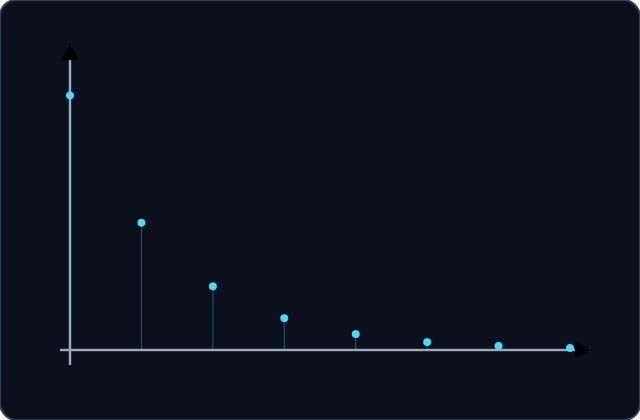
The bars are the numbers bounding at every point. If they add to something finite, the series of functions converges uniformly — and the tail beyond any stage is as small as the tail of the numbers.
The M-test
Let be a series of functions on and suppose for every , with convergent. Then converges uniformly and absolutely on . The proof is the Cauchy criterion for uniform convergence: a block of the series of functions is bounded by the matching block of the series of numbers, which is small.
Using it
- The bounds must not depend on the point; that is what makes the conclusion uniform.
- It gives uniformity without the limit being known, since the Cauchy criterion names no limit.
- The test is sufficient and not necessary: a series can converge uniformly without the sizes of its terms being summable.
- Combined with the last three lessons: a uniformly convergent series of continuous functions has a continuous sum, and may be integrated term by term.
- converges uniformly on , by , so its sum is continuous everywhere.
Weierstrass's M-test
Use the Cauchy criterion, so that no limit has to be produced. A block of consecutive partial sums of the series of functions is a sum of finitely many terms, and its size at any point is at most the sum of the matching bounds, by the triangle inequality. That last quantity is a block of the convergent series of numbers, so it is small past some stage — and the stage does not depend on the point, since the bounds do not. That is exactly the Cauchy criterion for uniform convergence.
Proof steps
The triangle inequality on a finite sum.
Each term is bounded by its number, at every point.
The Cauchy criterion for the series of numbers, from chapter five.
The bounds do not depend on the point, so neither does the stage.
Which is the Cauchy criterion for uniform convergence.
Applications
Practice
Bound Each Term by a Number
The bound must work at every point, and the numbers must add to something finite.
Try it
What does the M-test require?
Try it
Which bound shows that converges uniformly on ?
Try it
A uniformly convergent series of functions always satisfies the M-test.
Try it
Why does the test not need the sum of the series to be known?
Try it
for . What does the M-test give as a bound for ?
Try it
The M-test gives absolute convergence as well as uniform convergence.
What the Test Buys, With the Last Three Lessons
Uniformity is the hypothesis every theorem of this chapter wants.
- A uniform limit of continuous functions is continuous.
- A uniformly convergent series may be integrated term by term.
- Differentiation still needs the hypothesis on the derivatives.
Try it
passes the M-test on and every is continuous. What follows?
What You Learned
- The M-test bounds each term by a number valid at every point.
- If those numbers form a convergent series, the series of functions converges uniformly and absolutely.
- It needs no knowledge of the sum, being an application of the Cauchy criterion.
- It is sufficient and not necessary.
Final checkpoint
Try it
Which series passes the M-test on ?
Try it
In the M-test the bound may depend on the point.
Completion
Lesson complete
Great work! You now know how to:
- State the M-test and say why its bounds must be numbers
- Apply it to a trigonometric series
- Say what it gives besides uniformity, and what it does not
- Combine it with the theorems of this chapter