Intuition
The first of the three repairs. A uniform limit of continuous functions is continuous, and the proof is the argument every analyst knows by the number of times the tolerance is divided: a third for getting from the limit to a function of the sequence, a third for the continuity of that function, and a third for getting back. Uniformity is what makes the first and last thirds available at every point at once.
To show two distant things are close, route through a third that is close to both. Here the third thing is one function of the sequence, chosen late enough that it is close to the limit everywhere — and "everywhere" is what uniformity supplies and pointwise convergence does not.
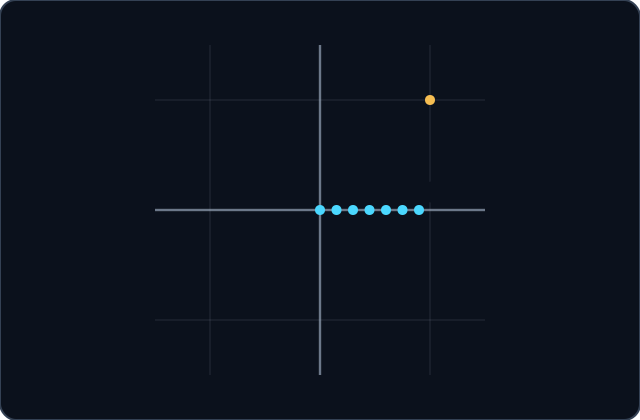
The pointwise limit of on : zero everywhere except at the right endpoint. Every function in the sequence is a polynomial, and the limit is not continuous — which is exactly what uniformity forbids.
The theorem, and the three thirds
If each is continuous on and uniformly on , then is continuous on . The proof estimates by routing through for a stage chosen once for the whole set, and each of the three pieces is made smaller than a third of the tolerance.
What it does and does not settle
- The contrapositive is the usual working form: if the pointwise limit of continuous functions is discontinuous, the convergence is not uniform.
- So on is not uniformly convergent, and no computation of a supremum is needed to see it.
- Uniformity is sufficient and not necessary: a sequence of continuous functions can converge pointwise but not uniformly to a continuous limit.
- The same argument shows that a uniform limit of bounded functions is bounded, and that a uniform limit of uniformly continuous functions is uniformly continuous.
- Only continuity at each point is proved; a uniform limit of differentiable functions need not be differentiable, which is two lessons away.
A uniform limit of continuous functions is continuous
Route through one function of the sequence. Given a tolerance, uniformity supplies a stage at which that function is within a third of the tolerance of the limit at every point at once; fix it. That function is continuous at the point in question, so it supplies a radius within which its own values move by less than a third. For an input inside that radius, go from the limit to the chosen function, across by its continuity, and back to the limit — three steps, each under a third.
Proof steps
Uniformity gives one stage good at every point at once.
That function is continuous at the point, so it supplies a radius.
Insert the chosen function twice and use the triangle inequality.
The outer two pieces are uniformity and the middle one is continuity.
The point was arbitrary, so the limit is continuous on the whole set.
Applications
Practice
Three Pieces, Each a Third
Route from the limit through one function of the sequence and back.
Try it
Which piece of the three-thirds argument uses uniformity?
Try it
Because the pointwise limit of on is discontinuous, the convergence is not uniform.
Try it
Is uniform convergence necessary for the limit to be continuous?
Try it
Into how many pieces is the tolerance divided in the standard proof?
Try it
A uniform limit of uniformly continuous functions is uniformly continuous.
Try it
uniformly on and each is bounded. What follows?
Try it
Which sequence shows that pointwise convergence is not enough?
What You Learned
- A uniform limit of continuous functions is continuous.
- The proof routes through one function of the sequence and splits the tolerance in three.
- The contrapositive is the quickest test for non-uniformity.
- The theorem is sufficient and not necessary, and says nothing about derivatives.
Final checkpoint
Try it
A sequence of continuous functions converges pointwise to a discontinuous function. The convergence is not uniform.
Try it
Why can the proof not be run with pointwise convergence?
Completion
Lesson complete
Great work! You now know how to:
- Prove that a uniform limit of continuous functions is continuous
- Say where uniformity is used in the three-thirds argument
- Use the contrapositive to rule out uniform convergence
- Say what the theorem does not claim